

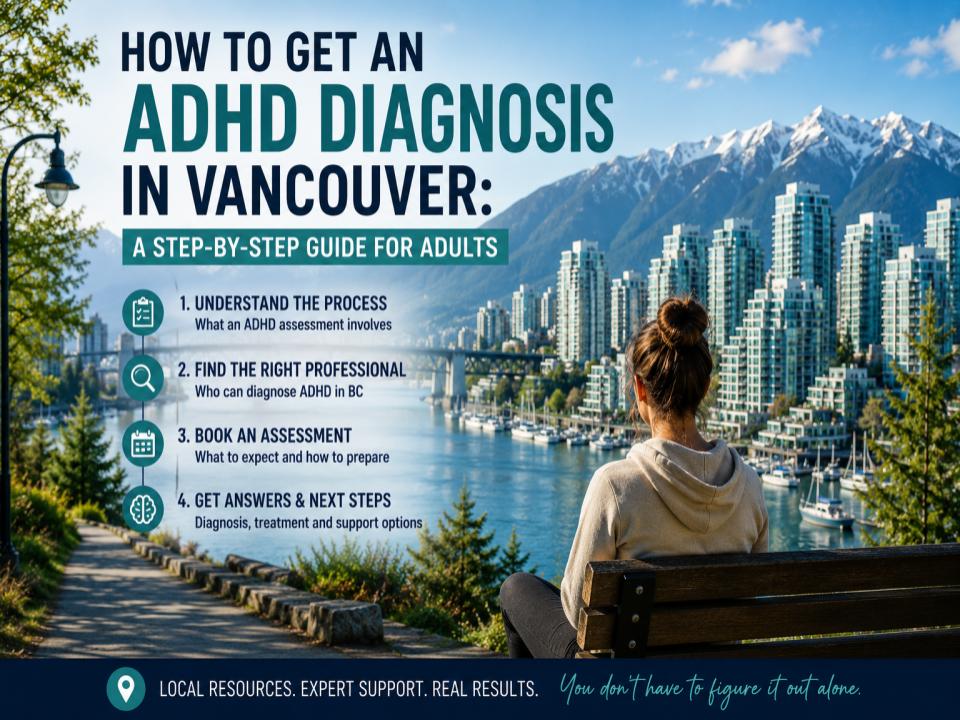
 How to Get an ADHD Diagnosis in Vancouver: A Step-by-Step Guide for Adults
You suspect you have ADHD. Maybe a friend mentioned it. Maybe a TikTok video hit too close to home. Maybe you have spent years wondering why simple tasks feel so hard. Whatever brought you here, one question keeps coming back: what do I actually do next?
This guide answers that question. How to Get an ADHD Diagnosis in Vancouver: A Step-by-Step Guide for Adults walks you through every stage of the process, from your first appointment to your final report. You will learn who can diagnose ADHD in British Columbia, what MSP covers, how long you might wait, and what a private assessment actually costs. The system can feel confusing, but the path forward is more straightforward than it looks.
Let us break it down step by step.
Step 1: Recognize the Signs of Adult ADHD
Adult ADHD looks different from the childhood stereotype. You may not bounce around a classroom. Instead, you might sit at your desk for hours and get almost nothing done. Your mind races. You lose your keys. You start ten projects and finish none of them.
Common adult ADHD symptoms include chronic procrastination, poor time management, forgetfulness, difficulty starting tasks, emotional sensitivity, restlessness, impulsive spending, and trouble finishing what you begin. Many adults also describe a lifelong sense of underachieving despite obvious intelligence and effort.
Before you book an appointment, spend a bit of time reflecting. Write down specific examples from your life. Think about school report cards, past jobs, relationships, and daily routines. ADHD is a lifelong condition. A clinician will want to see patterns that stretch back to childhood, not just recent stress.
You can also try a free screening tool. The Adult ADHD Self-Report Scale (ASRS) from the World Health Organization takes about five minutes and gives you a snapshot of your symptoms. Keep in mind that no online quiz can diagnose ADHD. These tools only tell you whether a full assessment might be worthwhile.
If you want to understand adult ADHD in more depth, the Centre for ADHD Awareness Canada (CADDAC) and the ADHD BC Society offer excellent free resources. Reading through their material can help you decide whether to pursue formal diagnosis.
 Step 2: Understand Who Can Diagnose ADHD in British Columbia
Before you pick a route, you need to know who is legally allowed to diagnose ADHD in BC. Four types of professionals can do it: family doctors (GPs), psychiatrists, registered psychologists, and nurse practitioners. Each one comes with different costs, wait times, and levels of detail.
Family doctors can diagnose ADHD when they feel comfortable doing so. Some are excellent at it. Others prefer to refer you to a specialist, especially if your case is complex or involves overlapping conditions like anxiety, depression, or trauma.
Psychiatrists are medical doctors who specialize in mental health. Their assessments are covered by MSP if you have a referral from your GP or nurse practitioner. Wait times through the public system are long, but the cost is zero.
Registered psychologists can perform detailed psychoeducational assessments. These reports are thorough and often required for school accommodations, the federal Disability Tax Credit, and workplace requests. Psychologists are not covered by MSP, so you pay out of pocket.
Nurse practitioners are a newer and increasingly popular option. Since a 2023 regulatory update from the BC College of Nurses and Midwives, nurse practitioners in BC have full authority to diagnose adult ADHD and prescribe stimulant medication. Many NP-led virtual clinics have short wait times, though most operate privately.
Knowing your options up front saves months of confusion. Now you can pick the path that fits your budget and timeline.
Step 3: Start With Your Family Doctor or Nurse Practitioner
For most people in Vancouver, the process begins with a visit to a family doctor or nurse practitioner. This is the gatekeeping step that opens the rest of the system.
Book a dedicated appointment specifically about ADHD. Do not tack it onto a checkup for something else. ADHD is complex, and you want your provider’s full attention. When you book, ask the receptionist for a longer appointment slot if possible.
Come prepared. Bring a written list of symptoms, examples from your childhood, old report cards if you have them, and any patterns you have noticed at work or in relationships. Preparation matters because the appointment will feel short, and you want to make every minute count.
Ask your doctor these direct questions. Do you diagnose adult ADHD yourself? If not, who do you usually refer patients to? How long is the current wait? Can you write me a referral to a specific clinic if I request one?
If you do not have a family doctor, you have options. The Health Connect Registry connects BC residents to family practices accepting new patients. Walk-in clinics can start the conversation, though they may not follow you long-term. HealthLink BC (dial 8-1-1) can also point you toward mental health resources in your area.
Some GPs will diagnose you on the spot after a few conversations. Others will refer you to a psychiatrist. Both outcomes are valid. What matters is starting the clinical conversation.
 Step 4: Weigh the Public (MSP) Route Against Its Wait Times
The public system offers ADHD assessment at no cost. This is the most affordable pathway, but it comes with a serious trade-off: time.
Wait times for a public psychiatric assessment in Metro Vancouver currently range from six to eighteen months. In some cases they stretch beyond two years. Rural BC waits are even longer. Demand for adult ADHD services has grown sharply over the past decade, and the number of psychiatrists has not kept pace.
Two well-known public options exist. The UBC Hospital Mood Disorders Clinic accepts referrals for various conditions including ADHD. Vancouver Coastal Health operates regional mental health services that may include ADHD assessment depending on your neighbourhood.
Some hybrid clinics offer MSP-covered assessments performed by physicians while charging for additional testing components not covered by the provincial plan. Level Up ADHD, based in Vancouver, offers MSP-covered ADHD assessments with their physicians, though referrals must come from a doctor or nurse practitioner. Note that some of these clinics periodically pause new referrals due to demand, so call before you get your hopes up.
The public route makes sense if you can wait and your symptoms are not causing severe daily impairment. It also makes sense if you have limited budget and cannot afford a private assessment. If your daily functioning is deeply affected, or you need answers to make career or academic decisions soon, waiting one to two years may not be practical.
Ask your GP to submit multiple referrals if possible. Getting on more than one waitlist can shorten your total wait.
Step 5: Explore Private Assessment Options
Private assessment is the path most Vancouver adults now choose. Wait times drop from months to weeks. In exchange, you pay out of pocket.
Costs vary widely based on the type of provider. A private psychiatrist assessment typically runs $300 to $600. A nurse practitioner-led clinical assessment costs $399 to $800. A full psychoeducational assessment by a registered psychologist ranges from $1,500 to $3,500. The higher-priced psychoeducational assessments include cognitive testing, learning assessments, and detailed reports suitable for school accommodations or Disability Tax Credit applications.
Several private clinics in Vancouver specialize in adult ADHD. West Coast Adult ADHD offers virtual assessments by nurse practitioners across BC, typically priced around $399 for the initial assessment and treatment plan. Sparrow ADHD & Wellness provides online NP-led assessments and follow-up counselling. The Adult ADHD Centre offers telehealth assessments across Canada. Cognostic in Vancouver conducts in-depth psychoeducational assessments through registered psychologists.
Before booking, ask each provider a few key questions. Do you have experience diagnosing adult ADHD, including in women and adults who developed coping strategies to mask symptoms? Can you prescribe medication if I receive a diagnosis? Will I receive a written report? Is the report accepted by insurance providers, schools, and employers?
Extended health insurance may cover part of the cost. Most Vancouver-area workplace benefits plans include $500 to $2,000 per year for psychological services. Some enhanced plans reach $5,000. Contact your insurer before booking to confirm what is covered. Registered psychologist assessments are usually eligible for partial reimbursement. Nurse practitioner and psychiatrist assessments may not be, depending on the plan.
Virtual assessments have become the norm for many providers. Research suggests virtual ADHD assessments produce reliable results when conducted properly with comprehensive interviews and validated tools. If you live in Vancouver but prefer to stay home, virtual options are widely available.
 Step 6: Prepare for Your Assessment
Preparation is where many people undersell themselves. ADHD assessment relies heavily on your ability to describe patterns over your lifetime. If you show up unprepared and blank on details, you may not get an accurate diagnosis.
Start by writing a personal history. Break it into three eras: childhood (before age twelve), adolescence and young adulthood, and current life. For each era, list concrete examples of attention challenges, impulsivity, disorganization, or emotional regulation issues.
Gather old records. Report cards from elementary and high school can reveal early symptoms. Teacher comments about daydreaming, incomplete work, or trouble focusing are gold. Old employment reviews may also show patterns.
Ask someone close to you to fill out a collateral questionnaire. Most clinicians want input from a partner, parent, sibling, or close friend. This person confirms what you describe and provides an outside view of your behaviour. Adults with ADHD often underreport their own symptoms because the patterns feel normal to them.
Prepare examples across multiple life domains. Work, school, finances, relationships, driving, household management, and self-care all matter. If you can describe how ADHD shows up in your bank account, your car, your kitchen, and your inbox, your clinician has a much clearer picture.
Bring a written summary to your appointment. Two to four pages is plenty. This document keeps you organized when the appointment feels overwhelming. It also becomes part of your clinical record.
Finally, sleep well the night before. Take your regular medications. Eat something. You want to arrive as your baseline self, not a stressed and hungry version of yourself.
Step 7: What Happens During the Assessment
ADHD assessment is a conversation, not a lab test. There is no brain scan or blood test that confirms ADHD. Instead, your clinician gathers information from many sources and applies the diagnostic criteria in the DSM-5-TR.
The DSM-5-TR requires that adults show at least five symptoms of inattention and/or five symptoms of hyperactivity-impulsivity, with symptoms present since before age twelve, symptoms causing impairment in two or more settings, and symptoms not better explained by another condition.
A typical clinical assessment lasts sixty to ninety minutes for a nurse practitioner or psychiatrist. Psychoeducational assessments by psychologists can run six to twelve hours across multiple sessions, since they include cognitive testing and learning evaluations.
Expect a detailed conversation about your childhood, school history, work history, relationships, and current daily life. Your clinician may use structured tools like the DIVA-5 interview or standardized rating scales such as the Conners Adult ADHD Rating Scales.
The clinician will also rule out other conditions that mimic ADHD. Anxiety, depression, sleep disorders, thyroid problems, trauma, and substance use can all produce ADHD-like symptoms. A good assessment carefully separates these possibilities before landing on a diagnosis.
If you receive a diagnosis, most clinicians deliver it during the same appointment or shortly after. You will typically receive a written report explaining the findings, treatment recommendations, and next steps. Ask for a copy of this report. You will need it for medication follow-ups, insurance, and any accommodations.
If you do not receive a diagnosis, that outcome still matters. It may mean another condition is driving your symptoms, and identifying that condition points you toward more useful treatment.
 Step 8: What to Do After Your Diagnosis
Getting the diagnosis is only the beginning. The next few months are about turning that piece of paper into real changes in your life.
Medication is the most researched treatment for adult ADHD. Stimulant medications like methylphenidate (Concerta, Ritalin) and amphetamine-based options (Adderall, Vyvanse) are the first-line treatments. Non-stimulants like Strattera and Wellbutrin are also used in specific cases. Your prescribing clinician will walk you through options and monitor your response.
Medication costs vary. Most stimulants run $80 to $250 per month without coverage. BC’s Fair PharmaCare program covers a portion of prescription costs on a sliding scale based on household income. Register at gov.bc.ca/pharmacare to see if you qualify.
Therapy is another key part of treatment. Cognitive behavioural therapy (CBT) adapted for ADHD helps you build practical skills for time management, task initiation, and emotional regulation. Look for a registered clinical counsellor or psychologist with specific ADHD training.
Coaching is often overlooked but incredibly useful. ADHD coaches specialize in helping you build systems, follow through on goals, and manage executive function challenges. Unlike therapy, coaching focuses on the practical here-and-now: how do you actually get out the door in the morning, finish your emails, and stop losing your wallet?
If your daily functioning is significantly impaired, you may qualify for the federal Disability Tax Credit. A psychoeducational report from a registered psychologist is typically required to support the application. If approved, the credit can be worth $1,500 to $2,500 per year in federal tax savings.
For workplace or academic accommodations, share your report with your HR department or accessibility office. Common accommodations include extended deadlines, flexible schedules, noise-cancelling headphones, private workspaces, and written instructions instead of verbal ones.
Community support also helps. CHADD Vancouver runs monthly support groups for adults in the area. Peer support can make a huge difference during those early weeks when you are still figuring out what ADHD means for your life.
Common Questions and Considerations
Do I need a diagnosis to make changes in my life? No. Many people benefit from ADHD-informed strategies without a formal diagnosis. However, you need a diagnosis to access medication, workplace accommodations, and the Disability Tax Credit.
Can my family doctor prescribe stimulants? Yes, if they diagnose you or accept a specialist’s diagnosis. Some GPs are hesitant with controlled substances and prefer to keep prescribing in specialist hands. Ask up front.
What if I have anxiety or depression too? Very common. Roughly half of adults with ADHD have at least one other mental health condition. A skilled clinician will assess and treat all of them, not just ADHD.
Do I need in-person assessment or is virtual fine? Both work. Virtual assessments have become mainstream and produce reliable results when performed by qualified clinicians. Choose based on convenience and provider fit, not format.
How do I know if a clinic is legitimate? Verify credentials with the College of Physicians and Surgeons of BC, the College of Psychologists of BC, or the BC College of Nurses and Midwives. All practicing clinicians in BC are listed in their respective college directories.
What about assessment for women? ADHD in women is often missed because symptoms present differently. Look for clinicians who specifically mention experience assessing adult women or people who have masked symptoms for decades. Not every provider has this expertise.
Conclusion
Learning how to get an ADHD diagnosis in Vancouver is really about learning how to navigate two overlapping systems: the free but slow public route and the faster but paid private route. Neither is better in absolute terms. The right choice depends on your budget, your timeline, and the urgency of your daily challenges.
Here is the main takeaway. Start by talking to your family doctor or a nurse practitioner about your symptoms. Get clear on whether you want to go through the public system (free, six to twenty-four months), a private psychiatrist or nurse practitioner (a few hundred to under a thousand dollars, weeks not months), or a full psychoeducational assessment by a registered psychologist (fifteen hundred to thirty-five hundred dollars, most detailed report). Prepare thoroughly for the appointment with examples, records, and collateral input. After the diagnosis, build a support system that includes medication if appropriate, therapy, coaching, and community.
You do not have to figure this out alone. Thousands of Vancouver adults have walked this exact path in the past few years. The system is imperfect, but the destination is worth the effort. An accurate diagnosis often reframes decades of self-criticism into something more accurate and much more workable.
If you are ready to start putting your ADHD diagnosis into action, check out affordable ADHD coaching options at ADHD Coaching Vancouver. Diagnosis is only the beginning. Coaching helps you turn that new understanding into real, day-to-day change.