

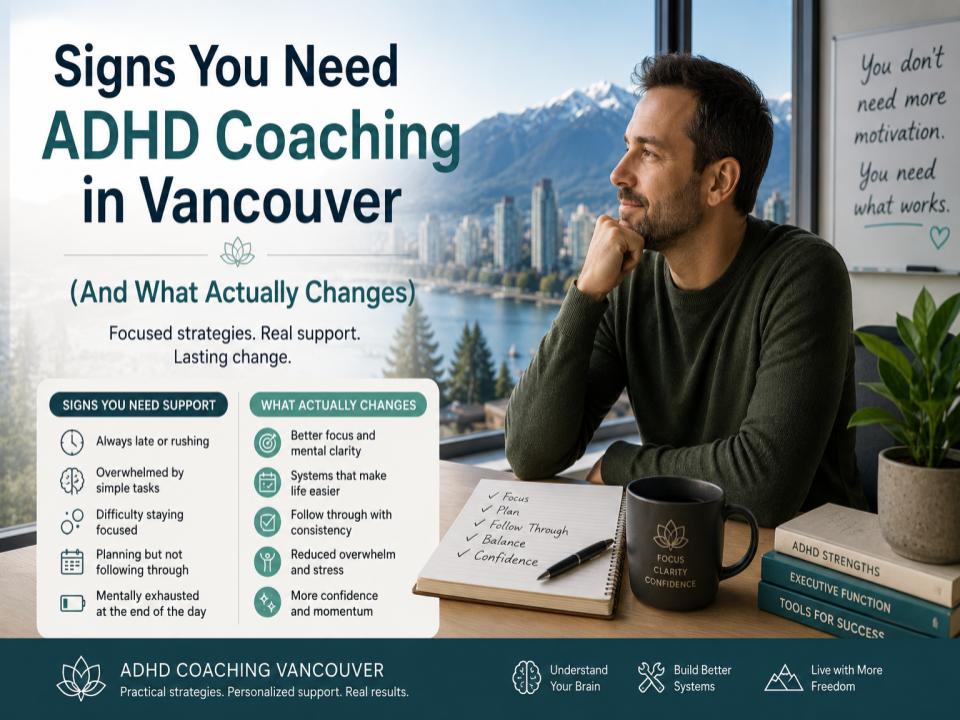
 Signs You Need ADHD Coaching in Vancouver (And What Actually Changes)
You forget appointments. You start five projects and finish none. You sit down to work and somehow lose two hours to a task that should take twenty minutes. If this sounds familiar, you have probably already searched for answers. Maybe you have read articles, tried apps, or bought another planner that now sits unused in a drawer.
At some point, a new question starts to surface: is this something coaching could actually help with? This article walks through the real signs you need ADHD coaching in Vancouver, and just as importantly, what actually changes once you start.
We will not oversell this. ADHD coaching is not a cure, and it will not make ADHD disappear. But for many adults, it closes the gap between knowing what to do and actually doing it. That gap is where most ADHD struggles live.
What ADHD Coaching Actually Is (And Isn’t)
Before looking at the signs, it helps to know what ADHD coaching means in practice, because the term gets used loosely.
ADHD coaching is a structured, collaborative process. A coach works with you to identify specific challenges, such as time blindness, task paralysis, or trouble following through on commitments. Together, you build systems and habits suited to how your brain actually works, not how a generic productivity book says it should work.
This is different from therapy. A therapist may help you process emotions, past experiences, or co-occurring conditions like anxiety or depression. A coach focuses on the present and future: what needs to happen this week, and how to make it happen. Many adults benefit from both, and a good coach will be upfront if a concern falls outside their scope and belongs with a licensed therapist or physician instead.
It is also different from medical treatment. Coaching does not diagnose ADHD and does not replace medication or clinical care. According to the Canadian ADHD Resource Alliance (CADDRA), ADHD is typically diagnosed by a physician or psychiatrist using standardized clinical criteria, and treatment often combines medical, behavioural, and psychosocial approaches. Coaching sits in that behavioural and psychosocial space, working alongside diagnosis and treatment rather than instead of it.
What makes coaching distinct is its practical, action-oriented nature. Sessions usually involve reviewing what worked and what didn’t since the last meeting, identifying obstacles, and building small, testable strategies for the week ahead. Over time, these small wins compound into real changes in how you manage your day.
Sign One: You Know What To Do, But You Can’t Start
This is the most common sign, and the most misunderstood one. People without ADHD often assume the problem is motivation or effort. It rarely is.
Task initiation is a specific executive function, and it is one of the areas ADHD affects most consistently. You can want to start a task, understand exactly how to do it, and still sit frozen in front of it for an hour. This is sometimes called task paralysis, and it is not laziness. It is a neurological hurdle in getting from “I should do this” to “I am doing this.”
If you routinely delay starting things you actually care about, that gap between intention and action is worth addressing directly. Coaching targets this specific hurdle with concrete starting rituals, because willpower alone rarely solves it.
Sign Two: Your Time Sense Is Unreliable
Ask yourself: do you regularly think a task will take 20 minutes, and it takes two hours? Or the reverse: do you avoid starting something because you assume it will take all day, when it actually takes fifteen minutes?
This is called time blindness, a term popularized by ADHD researcher Dr. Russell Barkley to describe the difficulty many people with ADHD have in accurately sensing the passage of time. It explains chronic lateness, all-nighters before deadlines, and the sense that time either drags or vanishes without warning.
Time blindness is not a character flaw. It is a measurable difference in how the ADHD brain processes time as a resource. A coach helps you build external time-tracking systems, visual timers, and check-in habits that compensate for this, because internal time sense often can’t be trained away on its own.
 Sign Three: You Have Tried Every System, And None Of Them Stick
Maybe you have downloaded a dozen productivity apps. Maybe you have read books on time management, bullet journaling, or the latest task-management method. Maybe each one worked for about a week before quietly falling apart.
This is one of the clearest signs that generic advice is not the issue. The issue is that most productivity systems are built for neurotypical brains, and they assume a level of consistent executive function that ADHD brains do not reliably produce. A coach does not hand you a system off the shelf. They help you build one around your actual patterns, including the ones you’re embarrassed about, like needing visual clutter to remember things exist.
The CHADD organization, a leading U.S. nonprofit focused on ADHD education and support, notes that individualized strategies tend to outperform one-size-fits-all approaches because ADHD presents differently in each person. This is exactly why a coach spends real time understanding your specific patterns before suggesting a single tool.
Sign Four: Your Relationships Are Absorbing The Fallout
ADHD rarely stays contained to work or school. It shows up at home too.
Forgotten commitments strain friendships. A partner tired of being the default reminder system starts to resent it. Family members interpret forgetfulness as not caring, when the truth is closer to an overloaded working memory. If you have noticed the people around you quietly picking up slack, or you sense growing frustration that you can’t quite explain, that is a sign worth taking seriously.
This pattern is well documented. Research summarized by the Centre for ADHD Awareness Canada (CADDAC) points to elevated rates of relationship strain among adults with untreated or unmanaged ADHD, driven largely by inconsistency rather than intent. Coaching won’t fix a relationship on its own, but building reliable systems reduces the friction that fuels these conflicts. When you follow through more consistently, trust rebuilds gradually, and that shift is often more meaningful to clients than any productivity gain.
Sign Five: You’re Exhausted From Masking
Masking means putting in extra, often invisible effort to appear organized, attentive, or “normal” in situations where your brain is working against you. It might look like intense concentration to hide that you didn’t follow a conversation, or elaborate note-taking to compensate for working memory gaps.
Masking is exhausting because it adds a second, hidden job on top of whatever you’re actually supposed to be doing. Many adults with ADHD, especially those diagnosed later in life, don’t realize how much energy masking consumes until they stop doing it, or until someone names the pattern for them.
If you end most days feeling depleted in a way that doesn’t match your actual workload, this is worth exploring. A coach can help you tell the difference between strategies that genuinely help and habits that are just exhausting performances of competence.
Sign Six: You’re Successful, But It Feels Unsustainable
This sign catches people off guard. Not everyone with unmanaged ADHD is visibly struggling. Some people build careers, raise families, and look, from the outside, like they have it together.
But underneath, it might be held up by chronic overwork, last-minute scrambling, or a pattern of crisis-driven productivity where nothing gets done until the deadline creates enough adrenaline to force focus. This works, until it doesn’t. Burnout tends to follow, often abruptly.
If your current success depends on constant urgency, that is not a sustainable system. It’s a pattern held together by stress hormones. Coaching helps shift you from crisis-driven output to more even, planned effort, which protects both your performance and your long-term health.
Sign Seven: You’ve Been Diagnosed, But Nothing Has Actually Changed
This one is specific and common. Getting a diagnosis is often described as a relief, and it usually is. Finally, there is a name for the pattern. But a diagnosis alone doesn’t rebuild your calendar, your inbox, or your morning routine.
Medication, when prescribed and monitored by a physician, can meaningfully improve focus and impulse control for many people. The Canada.ca health information page on ADHD outlines it as one part of a broader treatment approach that often includes behavioural strategies. Coaching is frequently that behavioural piece. It takes the clarity a diagnosis provides and turns it into daily practice.
If you were diagnosed months or years ago and still feel stuck in the same patterns, that gap between diagnosis and daily function is precisely what coaching is built to close.
What Actually Changes With ADHD Coaching
Signs are only half the picture. The more useful question is what changes once coaching actually starts. Here is what tends to shift, based on how the process is structured.
Your systems start matching your brain, not fighting it. Instead of forcing yourself into a planner style that never worked, you build routines around how you actually process information, whether that’s visual, verbal, or built around external accountability.
You get an accountability structure that isn’t a parent, partner, or boss. Regular check-ins create a low-stakes but consistent structure for following through, without the emotional weight that comes from disappointing someone close to you.
You learn to break tasks down to a size your brain will actually start. A vague, overwhelming task like “organize my finances” becomes a specific first step, small enough that the initiation barrier disappears.
You build self-awareness without self-judgment. A good coach helps you notice patterns, like when you tend to procrastinate or when your focus is naturally strongest, without turning that awareness into another source of shame.
Your relationships often improve as a side effect. As follow-through becomes more consistent, the friction that unreliability causes at home and at work tends to ease, not because you became a different person, but because your systems got more dependable.
None of this happens instantly. Coaching is iterative. Some weeks go well, some don’t, and a good coach treats both as useful information rather than failure.
Why Location and Local Context Matter
ADHD coaching can happen over video call from anywhere, and many people do exactly that. But there are reasons a Vancouver-based approach can matter.
Local coaches understand the specific pressures of life in this city: the cost of living, the commute patterns across the Lower Mainland, the seasonal darkness that affects energy and motivation through the winter months, and the pace of work culture in local industries like tech, healthcare, and construction. These aren’t universal stressors. They shape daily routines in ways a coach unfamiliar with the region might miss.
There’s also the matter of referral networks. A coach working in Vancouver is more likely to have working relationships with local psychiatrists, family doctors, and ADHD-specialized clinics, which matters if you’re navigating diagnosis, medication management, or need a referral for services coaching doesn’t cover. Organizations like Vancouver Coastal Health provide regional context on mental health and behavioural health resources that a local coach is more likely to be familiar with and can point you toward when needed.
None of this means a non-local coach can’t help you. It simply means local context can add a layer of practical relevance that’s worth factoring into your decision.
How To Know If You’re Ready To Start
Readiness for coaching isn’t about having your life fully together first, and it isn’t about hitting some crisis point either. A few honest signals tend to indicate the timing is right.
You’re ready if you’ve noticed a repeating pattern rather than a one-off bad week. Everyone has off days. Coaching helps with patterns that show up again and again, regardless of how motivated or well-rested you are.
You’re ready if you’ve already tried self-directed solutions and hit a ceiling. If you’ve read the books, downloaded the apps, and still feel stuck, that’s not a personal failure. It’s usually a sign that outside structure and accountability would help more than another solo attempt.
You’re ready if the cost of staying the same is becoming clear. That cost might be professional, financial, relational, or simply the exhaustion of always feeling behind. When that cost outweighs the effort of starting something new, it’s usually time.
You don’t need a diagnosis to start coaching, though many people pursue one alongside it. If ADHD traits are affecting your daily functioning, that’s a legitimate reason to seek support, whether or not you have a formal label yet.
 What A First Coaching Conversation Usually Looks Like
If you’re on the fence, it helps to know what the actual entry point looks like, because uncertainty about the process itself often delays people longer than the decision to seek help.
Most ADHD coaches start with an initial conversation, sometimes called a discovery call or consultation. This is not a therapy session, and it’s not a sales pitch, at least not from a coach worth working with. It’s a chance for you to describe what’s going on, and for the coach to explain how they work and whether it seems like a good fit.
From there, coaching typically moves into regular sessions, often weekly or biweekly, focused on specific goals you set together. These goals are usually concrete: managing a work project, building a morning routine, reducing missed deadlines, or improving follow-through on personal commitments. Progress gets reviewed regularly, and strategies get adjusted based on what’s actually working, not what should theoretically work.
The ADDitude magazine resource library, a widely cited publication focused on ADHD and executive function, offers extensive first-person accounts of what coaching relationships look like in practice, which can be a useful gut-check before you commit to trying it yourself.
Conclusion: Signs You Need ADHD Coaching in Vancouver (And What Actually Changes)
If you’ve made it this far, some of these signs probably felt familiar. Maybe it was the task paralysis, the unreliable sense of time, the exhaustion of masking, or the frustration of a diagnosis that hasn’t translated into real change yet.
The main takeaway is this: ADHD coaching does not change your brain, and it isn’t meant to. What it changes is the structure around your brain, the systems, routines, and accountability that let your actual strengths come through instead of getting buried under missed deadlines and unfinished plans. The signs you need ADHD coaching in Vancouver are rarely dramatic. They’re usually quiet, repeating patterns that you’ve learned to explain away. Naming them clearly is often the first real step toward change.
If you’re ready to get your ADHD in order, check out affordable ADHD coaching in Vancouver to see how a structured, local approach could work for you.