
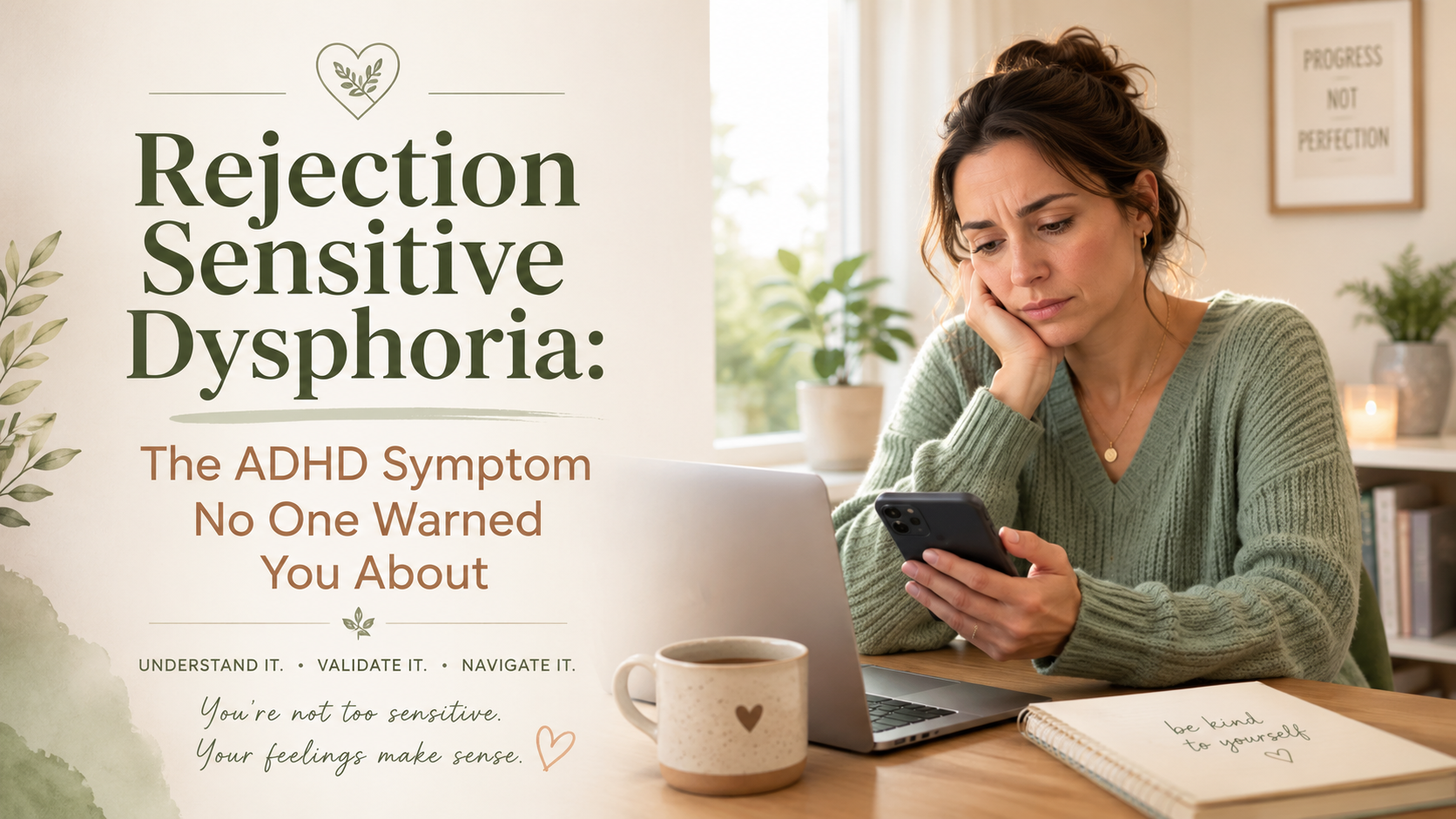
 Rejection Sensitive Dysphoria: The ADHD Symptom No One Warned You About
If a passing comment from your boss has ever ruined your entire week, you already know something about Rejection Sensitive Dysphoria. Maybe a friend didn’t text back fast enough, and your mind spiraled into “they must hate me.” Maybe you’ve turned down promotions or avoided dating altogether, just to sidestep the possibility of being criticized or rejected.
For a lot of people with ADHD, this isn’t occasional sensitivity. It’s a daily, exhausting reality. And most of them were never told it had a name.
Rejection Sensitive Dysphoria, or RSD, is one of the least talked-about parts of ADHD. It doesn’t show up in the official diagnostic checklist. Doctors rarely mention it at diagnosis. Yet many adults with ADHD say it’s the hardest part of the condition to live with — harder than forgetfulness, harder than distraction, harder than missed deadlines.
This guide explains what RSD actually is, why it happens, how to recognize it, and what actually helps. No fluff. Just the facts, explained clearly.
What Rejection Sensitive Dysphoria Actually Is
Rejection Sensitive Dysphoria describes an intense, often overwhelming emotional reaction to real or perceived rejection, criticism, or failure. The word “dysphoria” comes from Greek and means something close to “unbearable” or “difficult to bear.” That’s not an exaggeration for people who experience it. The pain triggered by a sense of being rejected or criticized by important people can feel severe, and the same is true when someone senses they’ve fallen short of their own or others’ expectations.
The term was popularized by psychiatrist Dr. William Dodson, who has worked with ADHD patients for decades. Dodson began describing RSD in the 1990s through lectures, interviews, and writing, defining it as extreme sensitivity to perceived or actual criticism. Since then, the concept has spread widely through ADHD communities, therapy practices, and online support spaces.
It’s important to be upfront about one thing: RSD is not an official medical diagnosis. It isn’t part of the formal diagnostic criteria for ADHD, but it’s still widely discussed among clinicians and within ADHD communities. You won’t find it listed in the DSM-5. That doesn’t mean it isn’t real. It means the research hasn’t fully caught up to what patients and clinicians have been observing for years.
What makes RSD distinct from ordinary sensitivity is intensity and speed. Everyone dislikes rejection. Most people can shake it off within a few minutes or hours. For someone with RSD, the emotional wave hits harder, lasts longer, and can trigger a physical reaction — a tight chest, a racing heart, or a wave of shame that feels disproportionate to what actually happened.
Why ADHD and RSD Are So Closely Linked
RSD isn’t randomly attached to ADHD. There’s a biological reason the two show up together so often.
ADHD affects far more than attention. It affects emotional regulation — the brain’s ability to manage the intensity and duration of feelings. Experts suspect RSD happens because of differences in brain structure, meaning the brain has trouble regulating rejection-related emotions and behaviors, which makes them feel much more intense. In other words, the ADHD brain doesn’t have the same built-in brakes that other brains use to slow down an emotional reaction before it becomes overwhelming.
This lines up with something clinicians have noted for a long time: emotional dysregulation is a core, if underappreciated, feature of ADHD. Dr. Dodson has explained that emotional dysregulation is one of the most important and debilitating features of ADHD, even though it doesn’t get the same attention as inattention or hyperactivity.
The numbers here are striking, even if they come from clinical observation rather than large-scale studies. Dodson has estimated that around 99 percent of people with ADHD experience RSD at some point, and roughly a third consider it the most difficult part of living with the condition. That’s a bigger claim than most people expect, especially since RSD rarely comes up in a typical ADHD diagnosis appointment.
Research backing this up is still developing, but it’s not absent. A qualitative study looking at adults with ADHD found that a large majority reported struggling with rejection sensitivity, even though it isn’t part of the formal ADHD criteria. In one study of adults aged 18 to 35, about 77 percent reported struggling with RSD, despite it not being included as a core ADHD symptom in the DSM-5-TR. This gap — between what patients experience and what’s officially recognized — is a big part of why RSD can feel so isolating. You’re dealing with something real, but it might not get acknowledged in a clinical setting.
It’s also worth noting that RSD isn’t exclusive to ADHD. Rejection sensitivity shows up in other psychiatric conditions too, but Dodson’s specific term, Rejection Sensitive Dysphoria, is one he considers largely exclusive to people with ADHD. The distinction matters less for day-to-day life and more for understanding that if you have both ADHD and intense rejection reactions, you’re not imagining a connection.
 What RSD Actually Feels Like
RSD doesn’t look the same for everyone, but there are recognizable patterns. Recognizing your own pattern is often the first step toward managing it.
Emotional flooding. A single sentence, look, or delay in a text reply can trigger a wave of sadness, anger, or panic that feels completely out of proportion to the trigger. People often describe intense and overwhelming feelings of sadness or rage after rejection, along with sudden mood swings and the sudden onset of anxiety or a depressive episode.
Shame spirals. RSD often comes with an inward turn — not just “that hurt,” but “I’m fundamentally the problem.” Deep shame, embarrassment, and self-blame are common reactions. This is different from typical disappointment. It attacks the sense of self, not just the moment.
Perfectionism as armor. Many people with RSD become high achievers, not out of ambition, but out of fear. If you’re flawless, no one can criticize you. According to Dodson, this creates a person who appears composed and accomplished on the outside while running on constant internal pressure — always producing, always afraid of being exposed as inadequate. It’s a defense mechanism that can look like drive but is often closer to dread.
People-pleasing. To avoid the risk of rejection altogether, some people with RSD say yes to everything, avoid conflict entirely, and suppress their own needs. Over time, this can lead to burnout and a loss of identity, since so much energy goes into managing other people’s perceptions.
Avoidance. This is one of the quieter, more damaging patterns. Someone might stop applying for jobs, stop pursuing relationships, or stop trying new things — not because they lack ambition, but because the anticipated pain of possible rejection outweighs the desire to try.
Physical symptoms. RSD isn’t only emotional. A racing heart, tight chest, or stomach drop can accompany the emotional wave, which is consistent with how the brain processes social pain. Research using brain imaging has found that rejection activates some of the same neural pathways as physical pain, which helps explain why rejection can feel almost physically injurious for people with heightened sensitivity.
How RSD Shows Up in Everyday Life
RSD rarely stays contained to one part of life. It tends to bleed into work, relationships, and self-image, often in ways people don’t immediately connect back to ADHD.
At work, RSD can look like avoiding feedback conversations, over-apologizing for small mistakes, or spiraling after a neutral comment in a performance review. Someone might turn down a leadership role because the increased visibility feels too risky. Others overwork constantly, terrified that any misstep will “prove” they don’t belong.
In relationships, RSD can create a push-pull dynamic. A partner’s short reply, a friend’s canceled plan, or a delayed response to a message can trigger disproportionate anxiety or anger. This isn’t about being dramatic. It’s the brain interpreting ambiguous signals as confirmed rejection, then reacting to that interpretation as if it were fact.
In parenting, adults with RSD may struggle with a child’s normal pushback or a teacher’s feedback about their kid, taking it as personal criticism of their parenting rather than routine information.
In social settings, RSD can cause someone to replay a conversation for days, convinced they said the wrong thing, even when nothing actually went wrong. This constant post-event analysis is mentally exhausting and can make socializing feel like a high-stakes activity rather than something enjoyable.
In self-talk, RSD often produces a harsh internal narrator. Small mistakes get inflated into evidence of being “bad at everything” or “impossible to love.” This isn’t a character flaw. It’s the emotional volume being turned up past a reasonable level, and it happens without the person choosing it.
Recognizing these patterns across different areas of life is useful because it shows that RSD isn’t a personality quirk showing up randomly. It’s a consistent response style connected to how the ADHD brain processes social and emotional information.
Why RSD Often Goes Undiagnosed
There are a few clear reasons RSD flies under the radar, even for people who’ve been managing ADHD for years.
First, it’s genuinely absent from the diagnostic manual. Rejection sensitive dysphoria cannot be formally diagnosed at this time, because mental health conditions are diagnosed using specific criteria listed in the DSM-5, and RSD isn’t part of that list. This means a clinician following the standard diagnostic script may never ask about it directly.
Second, RSD symptoms overlap with other conditions. Intense mood swings, shame, and emotional overwhelm can look like anxiety, depression, borderline personality traits, or bipolar disorder. Without specifically screening for the ADHD connection, a clinician might treat the mood symptoms without ever addressing the root cause.
Third, many adults with ADHD have spent years building coping mechanisms — perfectionism, avoidance, people-pleasing — that mask the underlying sensitivity. From the outside, someone might look “fine,” even successful, while privately managing constant emotional turbulence.
Fourth, RSD is more commonly discussed in relation to adult ADHD than childhood ADHD, partly because children may not have the vocabulary to describe what they’re feeling, and partly because adult social and professional environments create more opportunities for the kind of ambiguous, high-stakes feedback that triggers RSD.
This is exactly why the research gap matters. A 2023 qualitative study found that rejection sensitivity involves dysphoria triggered by perceived or real rejection and criticism, and people who experience it detect rejection more readily and perceive it more frequently than others do. That same research noted an important nuance: the source of rejection sensitivity is disputed, and some evidence suggests childhood interpersonal trauma, such as caregiver rejection, may also play a contributing role. This doesn’t contradict the ADHD connection. It suggests RSD may have more than one contributing pathway, and that both brain-based and experience-based factors can shape how intensely someone reacts to rejection.
 How Rejection Sensitive Dysphoria Is Treated
Even though RSD isn’t an official diagnosis, it is manageable. Several approaches have shown real benefit, and most people find a combination works best.
Medication. ADHD stimulant medications, which improve executive function and emotional regulation, sometimes reduce RSD symptoms as a secondary benefit. Some clinicians also use certain blood pressure medications, called alpha agonists, off-label to help blunt the emotional intensity of RSD reactions. This should always be discussed with a prescribing physician, since medication decisions depend on individual health history.
Therapy. Cognitive behavioral therapy (CBT) helps people identify and challenge the automatic thoughts that fuel RSD spirals — catching the leap from “they didn’t reply” to “they hate me” before it takes over. Dialectical behavior therapy (DBT) skills, particularly those focused on distress tolerance and emotional regulation, are also frequently used, since DBT was originally designed for exactly this kind of emotional intensity.
Building self-awareness. Learning to recognize an RSD reaction as it’s happening — rather than being swept up in it — is one of the most practical tools available. This often starts with simply naming it: “This is RSD talking, not necessarily reality.” That small pause can interrupt the spiral before it fully takes hold.
Coaching and structured support. ADHD coaching focuses on building practical strategies for daily life, including how to pause before reacting, how to reframe perceived rejection, and how to build routines that reduce the number of high-stakes, ambiguous situations that tend to trigger RSD in the first place. Coaching isn’t a replacement for therapy or medical treatment, but it complements both by focusing on real-world application.
Lifestyle factors. Sleep, exercise, and stress management all affect emotional regulation broadly, and ADHD brains are often more sensitive to disruptions in these areas. Poor sleep, in particular, tends to amplify emotional reactivity, which can make RSD symptoms noticeably worse.
The goal of treatment isn’t to eliminate emotional sensitivity altogether. It’s to shrink the gap between the trigger and the reaction, so a passing comment doesn’t derail an entire day.
It also helps to set realistic expectations. RSD tends to improve with consistent effort, but it rarely disappears completely. Most people describe progress as fewer spirals, shorter spirals, and faster recovery — not a total absence of emotional reactivity. That’s still a meaningful shift, especially for someone who has spent years feeling controlled by these reactions.
RSD Versus Everyday Sensitivity: How to Tell the Difference
One common question is how to know if you actually have RSD, or if you’re just someone who takes things personally. There’s no formal test, but a few distinctions tend to hold up.
Speed matters. RSD reactions tend to arrive almost instantly — within seconds of the perceived trigger — rather than building gradually over a conversation or a day.
Disproportion matters. The emotional response is often far bigger than the situation calls for. A minor scheduling mix-up can feel, in the moment, like proof that a friendship is ending.
Physical involvement matters. Ordinary disappointment usually stays in the emotional realm. RSD often pulls in the body too — a flushed face, a knot in the stomach, a sudden urge to leave the room.
Duration matters. Typical sensitivity fades within a short window. RSD can linger for hours, replaying the moment on a loop long after the original event is over.
None of these are diagnostic criteria in a clinical sense, since RSD doesn’t have official ones. But taken together, they help distinguish an intense but ordinary emotional reaction from the specific pattern people with ADHD describe when they talk about RSD.
 What You Can Do Starting Today
If RSD sounds familiar, here are a few starting points that don’t require a diagnosis or a prescription.
Name it. Simply knowing the term “Rejection Sensitive Dysphoria” can be a relief. It turns an experience that felt like a personal failing into a recognized pattern with a name and a cause.
Track your triggers. Notice what specifically sets off the spiral — a certain tone of voice, a delayed reply, a specific type of feedback. Patterns become easier to manage once they’re visible.
Build a pause. Before reacting to a perceived slight, try waiting even five minutes. RSD reactions are fast and intense, but they often lose some of their grip with a short delay.
Talk to a professional. A doctor or therapist familiar with adult ADHD can help distinguish RSD from other conditions and build a treatment plan suited to your specific situation.
Consider structured support. Many adults with ADHD find that having consistent, practical guidance — someone to help build routines and strategies around emotional triggers — makes a meaningful difference in daily life, even outside of clinical treatment.
For further reading, organizations like CHADD and the Attention Deficit Disorder Association offer detailed, clinically reviewed resources on ADHD and emotional regulation. The Cleveland Clinic also has a clear medical overview of RSD symptoms and treatment options, which is a useful starting point before a doctor’s appointment.
Conclusion: Rejection Sensitive Dysphoria — The ADHD Symptom No One Warned You About
Rejection Sensitive Dysphoria is real, common, and deeply tied to how the ADHD brain regulates emotion. It isn’t in the diagnostic manual, and most people are never warned about it when they’re diagnosed with ADHD. But for a huge number of adults with ADHD, it’s one of the most disruptive parts of the condition — shaping careers, relationships, and self-image in ways that often go unrecognized for years.
The main takeaway is simple: if ordinary criticism or rejection has ever felt unbearable, disproportionate, or physically painful, you’re not overreacting and you’re not broken. There’s a documented, brain-based reason this happens, and it has a name. More importantly, it’s manageable. Medication, therapy, self-awareness, and structured coaching all offer real paths forward. Understanding RSD is the first step toward loosening its grip on daily life.
If you’re ready to get your ADHD in order and want practical, personalized support, check out affordable ADHD coaching. Structured coaching can help you build real strategies for managing RSD and the rest of what ADHD brings to daily life.