

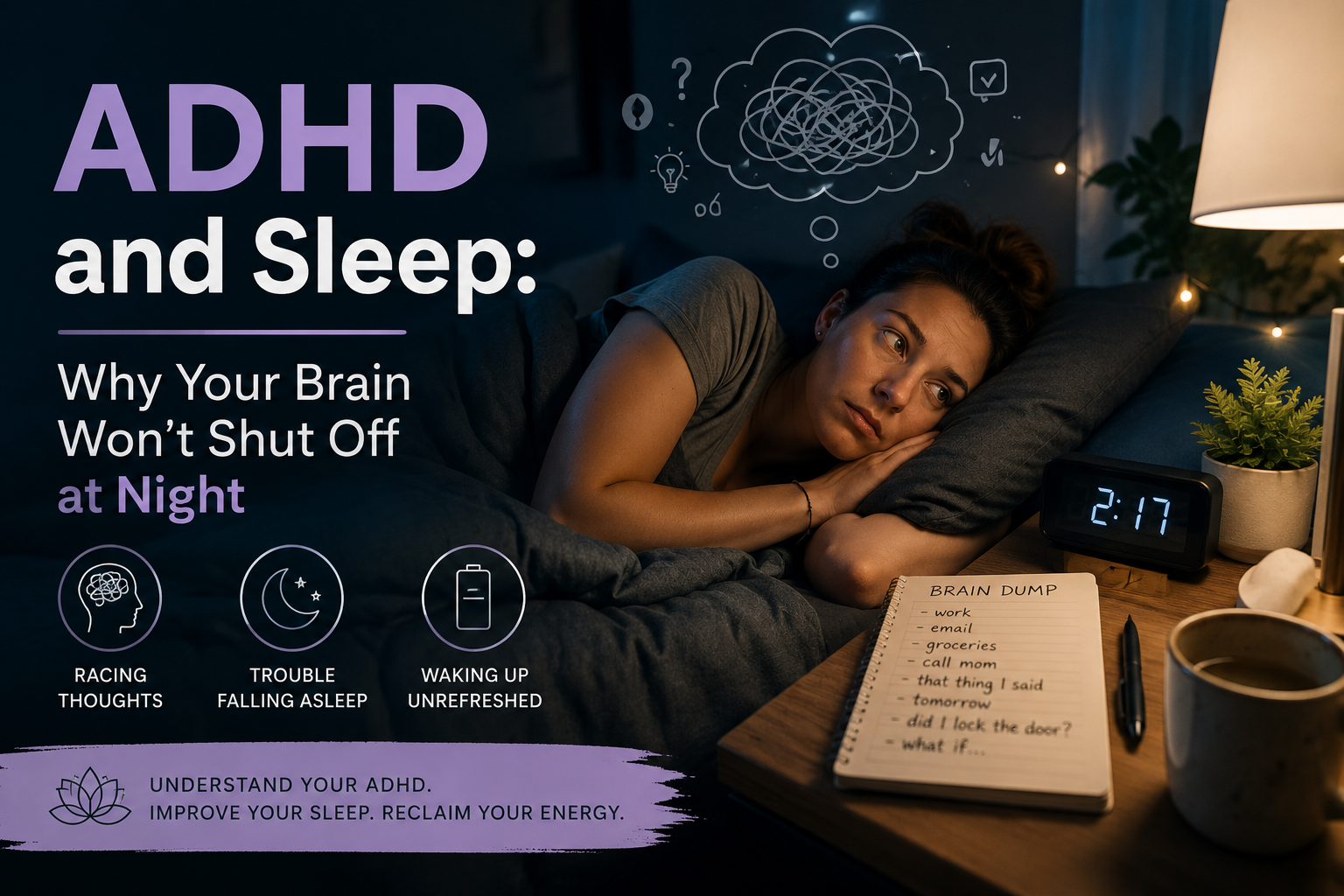
 ADHD and Sleep: Why Your Brain Won’t Shut Off at Night
You’re exhausted. Your body is tired. But your brain has other plans.
Ten minutes turns into an hour. One hour turns into three. You scroll, you replay conversations, you think of that email you forgot to send, and somehow it’s 2 a.m. again.
If this sounds familiar, you’re not alone, and you’re not broken. This is one of the most common — and least talked about — parts of living with ADHD. ADHD and Sleep: Why Your Brain Won’t Shut Off at Night isn’t just a catchy phrase. It’s a nightly reality for millions of people.
This article breaks down why ADHD makes sleep so hard, what’s actually happening in your brain and body, and what you can do to finally get some rest.
The ADHD Brain Doesn’t Have an “Off” Switch
Most people picture ADHD as a daytime problem: trouble focusing at work, losing keys, forgetting appointments. But ADHD doesn’t clock out at night. It just changes shape.
During the day, ADHD often looks like distraction. At night, it often looks like an inability to quiet down. The same neurological traits that make it hard to focus on a boring task in the afternoon make it hard to stop focusing on your thoughts at midnight.
This isn’t a matter of willpower. ADHD affects how the brain regulates attention, arousal, and stimulation. When the day’s distractions disappear, your brain doesn’t relax. Instead, it searches for something else to latch onto. That something is usually your own thoughts, and they tend to arrive uninvited and out of order.
Researchers have also found that ADHD is linked to differences in dopamine and norepinephrine regulation, two brain chemicals involved in both attention and arousal. Low or irregular activity in these systems may explain why the ADHD brain struggles to downshift from “on” to “off,” even when the body is worn out.
This mismatch between physical tiredness and mental alertness is one of the defining features of ADHD-related sleep struggles. You can be exhausted and wide awake at the exact same time. That’s not a contradiction. It’s how the ADHD brain works.
 ADHD and Delayed Sleep Phase: A Body Clock That Runs Late
One of the most well-documented connections between ADHD and sleep involves the body’s internal clock, known as the circadian rhythm.
Research shows that a striking number of people with ADHD have what’s called Delayed Sleep Phase Syndrome (DSPS), a condition where the internal clock runs later than average. One study found that up to 78% of adults with ADHD show signs of a delayed circadian rhythm. Other research places the estimate at roughly 73% to 78% of children and adults with ADHD.
In practical terms, this means your body doesn’t start producing melatonin, the hormone that signals it’s time to sleep, until later in the evening than it does for most people. You might feel truly sleepy for the first time around 1 or 2 a.m., no matter how early you get into bed.
This is different from ordinary insomnia. With classic insomnia, a person struggles to fall asleep even when their body is ready to. With delayed sleep phase, the body genuinely isn’t ready yet. Sleep specialists note that DSPS is often mistaken for poor sleep hygiene, when the real issue is a mistimed internal clock.
This distinction matters. If you’ve spent years blaming yourself for “bad habits,” it may be more accurate to say your internal clock is simply out of sync with a 9-to-5 world. Some studies have specifically noted that ADHD combined-type presentations are more associated with these circadian rhythm problems, while inattentive-type ADHD is more linked with excessive daytime sleepiness. Either way, the pattern is consistent: ADHD and circadian timing are connected at a biological level, not just a behavioral one.
Racing Thoughts, Hyperfocus, and the Bedtime Trap
Bedtime should be a wind-down. For many people with ADHD, it becomes the opposite: the one quiet window in the day when the brain finally has room to think.
During the day, work, conversations, and responsibilities absorb your attention. At night, that external noise disappears. What fills the silence is often a flood of thoughts: unfinished tasks, replayed conversations, ideas, worries, and random tangents that seem to multiply the moment your head hits the pillow.
This is sometimes called “revenge bedtime procrastination” when it’s intentional, but for many people with ADHD, it isn’t a choice at all. It’s the brain doing what it does best: seeking stimulation. Ironically, lying still in a dark, quiet room is one of the least stimulating environments possible, and the ADHD brain often responds by generating its own stimulation internally, in the form of racing thoughts.
Hyperfocus plays a role here too. Many people with ADHD know the experience of getting absorbed in a task, a show, a game, or a scrolling session, and losing complete track of time. At night, this can mean “I’ll just finish this one episode” turns into an entire season. The same intense focus that can make someone incredibly productive during the day can just as easily keep them up long past a reasonable bedtime.
This combination, a body that isn’t ready to sleep, a mind that won’t stop generating thoughts, and a tendency toward hyperfocus, creates a perfect storm. It’s not laziness or poor discipline. It’s the direct result of how ADHD affects attention regulation, whether that attention is pointed at a screen or at your own racing mind.
 The Two-Way Street: How Poor Sleep Makes ADHD Symptoms Worse
Here’s the part that makes this cycle so frustrating: ADHD makes sleep harder, and poor sleep makes ADHD symptoms worse. It’s a loop, not a one-way street.
Sleep deprivation affects everyone’s focus, mood, and patience. But for someone with ADHD, the effects are often magnified. A brain that already struggles with executive function, impulse control, and emotional regulation has even fewer resources to draw on after a bad night’s sleep. Clinical research confirms that sleep issues can worsen core ADHD symptoms like focus, attention, and emotional regulation, creating a feedback loop that can be hard to break.
This explains why so many people with ADHD describe their mornings as a fog. Concentration is harder. Irritability rises. Small frustrations feel larger. Decision-making slows down. These aren’t just “bad ADHD days.” They are, in many cases, the direct downstream effect of a poor night’s sleep layered on top of an already taxed nervous system.
There’s also a diagnostic wrinkle worth knowing about. Sleep deprivation on its own can mimic ADHD symptoms in anyone, including trouble concentrating, forgetfulness, and restlessness. This means poor sleep doesn’t just worsen existing ADHD symptoms. In some cases, it can make symptoms look more severe than they actually are, or make an undiagnosed sleep disorder harder to tell apart from ADHD itself.
Breaking this cycle usually requires addressing both sides at once: managing ADHD symptoms during the day and treating the sleep problem directly at night. Treating only one side tends to leave the loop intact.
Common Sleep Disorders That Overlap With ADHD
ADHD rarely shows up to the sleep conversation alone. Several sleep disorders are far more common in people with ADHD than in the general population, and they often complicate the picture.
Delayed Sleep-Wake Phase Disorder, discussed earlier, is the most frequently reported. But it’s far from the only one. Restless Legs Syndrome (RLS), a condition involving uncomfortable sensations in the legs and an urge to move them, especially at night, is also strongly linked with ADHD. Some researchers believe RLS and ADHD may even share underlying issues with dopamine regulation, which would help explain why they so often appear together.
Insomnia, in the more general sense of difficulty falling or staying asleep, is also elevated in people with ADHD, independent of any circadian rhythm issue. Sleep apnea, a condition where breathing repeatedly stops and starts during sleep, has been observed at higher rates in people with ADHD as well, particularly in children, where enlarged tonsils or adenoids can be a contributing factor.
This overlap matters for a practical reason: not all ADHD-related sleep struggles have the same root cause, and they don’t all respond to the same fix. Someone with delayed sleep phase needs a different approach than someone with restless legs syndrome or obstructive sleep apnea, even though both might describe their problem the same way: “I can’t sleep.”
This is why a proper evaluation matters, ideally one that considers ADHD and sleep together rather than treating them as separate, unrelated issues. A doctor or sleep specialist can help identify which of these overlapping conditions might be at play, since guessing and self-treating can waste months of trial and error.
Do ADHD Medications Help or Hurt Sleep?
This is one of the most common questions people ask, and the honest answer is: it depends.
Stimulant medications, the most commonly prescribed treatment for ADHD, work by increasing dopamine and norepinephrine activity in the brain. For many people, this improves focus and reduces the racing, restless quality of ADHD during the day. But because these medications are stimulating by nature, taking them too late in the day can interfere with falling asleep at night.
That said, the relationship isn’t always straightforward. Some people with ADHD actually sleep better on stimulant medication, not worse. This is because the medication helps quiet the mental noise and restlessness that would otherwise keep them awake. Without medication, some individuals experience more racing thoughts and physical restlessness at bedtime, not less. This is one reason blanket statements like “stimulants always cause insomnia” don’t hold up for everyone.
Timing tends to matter more than the medication itself. Taking a stimulant too late in the afternoon or evening is more likely to cause sleep problems than the medication itself being inherently disruptive. Working with a prescriber to adjust timing, dosage, or formulation (immediate-release versus extended-release) can make a significant difference.
Non-stimulant ADHD medications work differently and tend to have a different sleep profile, sometimes causing drowsiness rather than wakefulness. This is worth discussing with a healthcare provider, since the right medication and timing combination varies significantly from person to person.
The key takeaway: medication effects on sleep are highly individual. What disrupts one person’s sleep might be exactly what helps another person quiet their mind enough to rest. This is a conversation to have with a prescriber, not something to guess at alone.
 Practical Strategies to Help Your ADHD Brain Wind Down
There’s no single fix, but there are strategies that consistently help. The goal isn’t to force sleep. It’s to reduce the barriers your brain puts in its own way.
Anchor your wake-up time, not just your bedtime. Because ADHD is so closely tied to circadian rhythm issues, waking up at a consistent time, every day, including weekends, helps regulate your internal clock more effectively than obsessing over bedtime alone. Over time, an earlier consistent wake time can help shift a delayed sleep phase forward.
Get bright light early, dim light late. Light is the single strongest signal your circadian rhythm responds to. Morning sunlight exposure, ideally within the first hour of waking, helps reset a delayed body clock. In the evening, dimming lights and reducing screen brightness signals to your brain that night is approaching. Some sleep specialists recommend light therapy as part of chronotherapy for ADHD-related delayed sleep phase, sometimes combined with melatonin under medical guidance.
Externalize your racing thoughts. Keep a notepad or phone by your bed. When a thought interrupts your wind-down, write it down instead of trying to hold onto it or solve it. This gives your brain permission to let it go, at least for tonight.
Build a “boring” transition routine. ADHD brains often crave stimulation, but bedtime needs the opposite. A short, low-stimulation routine, dimming lights, a warm shower, light reading, gentle stretching, gives your brain a predictable off-ramp instead of an abrupt stop.
Consider melatonin, with guidance. Research supports melatonin as an effective tool for shifting a delayed sleep phase, particularly in children and adolescents with ADHD, though evidence in adults is less established. Timing and dosage matter far more than most people realize, so this is worth discussing with a doctor rather than guessing.
Address the room, not just the routine. A cool, dark, quiet bedroom removes some of the sensory input that an ADHD brain might otherwise latch onto. Blackout curtains, white noise, and a comfortable temperature all reduce the number of things competing for your attention.
Separate “can’t sleep” time from “in bed” time. If you’re lying awake for more than twenty or thirty minutes, get up and do something quiet and low-stimulation in dim light, then return to bed once you feel drowsy. This helps your brain associate the bed with sleep rather than with frustration and wakefulness, which can otherwise become its own habit over time.
None of these strategies work like a switch. They work like gravity, small, steady pulls that shift your pattern over weeks, not one night.
How This Looks Different in Children vs. Adults
ADHD-related sleep struggles don’t look the same at every age, and recognizing the difference matters for figuring out what kind of help to seek.
In children, sleep problems often show up as resistance to bedtime, difficulty settling down after a busy day, frequent night waking, or early rising regardless of what time they fell asleep. Parents sometimes describe it as their child being “wired” right when the household is trying to wind down. Because children’s sleep needs are higher than adults’, even a modest delay in falling asleep can lead to noticeable next-day effects: more irritability, more meltdowns, and a harder time sitting still at school. This can create a confusing picture for teachers and parents, since a tired child with ADHD can look more hyperactive, not less, unlike an adult who simply looks fatigued.
In adults, the pattern shifts. Racing thoughts at bedtime, a strong pull toward late-night hyperfocus on screens or projects, and a genuinely delayed body clock tend to dominate. Many adults with ADHD describe feeling most alert, and most creative, late at night, which can make late bedtimes feel productive rather than problematic in the moment. The cost shows up the next morning instead: hitting snooze repeatedly, feeling foggy through the first few hours of the day, and relying on caffeine to compensate for lost sleep.
There’s also a practical difference in flexibility. Children’s schedules are largely set by school start times, which can clash badly with a delayed circadian rhythm. Adults sometimes have more control over their schedules, which can be an advantage, since aligning work hours with a natural chronotype is sometimes possible, but it can also make the problem easier to ignore for years if there’s no external pressure forcing a fix.
Regardless of age, the underlying mechanisms, delayed circadian timing, difficulty downshifting mental activity, and a higher rate of overlapping sleep disorders, tend to be the same. What changes is how the problem is expressed and how much external structure exists to catch it early.
 When to Seek Professional Support
If sleep struggles have gone on for months, or years, and self-help strategies aren’t moving the needle, it’s worth bringing in outside support. This isn’t a failure. It’s often the fastest way to real progress.
A doctor can screen for co-occurring sleep disorders like restless legs syndrome or sleep apnea, both of which are more common in people with ADHD and require their own specific treatment. A sleep specialist can assess whether delayed sleep phase syndrome is at play and recommend evidence-based approaches like chronotherapy or carefully timed melatonin.
It’s also worth talking to a prescriber if you suspect your ADHD medication is affecting your sleep, either by keeping you up or by wearing off too early and letting restlessness creep back in overnight. Adjustments to timing, dosage, or medication type are common and often solve the problem without needing to change your entire routine.
Beyond the medical side, structured support for managing ADHD as a whole, not just the sleep piece, can make a meaningful difference. Sleep problems rarely exist in isolation from the rest of ADHD’s daily challenges: time blindness, procrastination, emotional regulation, and difficulty following through on routines. Addressing ADHD more broadly often improves sleep as a side effect, simply because a calmer, more organized day leads to a calmer, more organized night.
Conclusion: Understanding ADHD and Sleep, and Why Your Brain Won’t Shut Off at Night
ADHD and Sleep: Why Your Brain Won’t Shut Off at Night comes down to one central idea: this isn’t a discipline problem. It’s a biological one.
A delayed circadian rhythm, a brain wired to seek stimulation, racing thoughts that fill the silence, and sleep disorders like restless legs syndrome that occur more often alongside ADHD all combine to make rest genuinely harder to reach. And because poor sleep worsens ADHD symptoms, the two feed each other in a loop that can feel impossible to escape without the right approach.
The good news is that this loop can be broken. Consistent wake times, smart use of light, medication timing adjustments, and professional support when needed can all help retrain a brain that’s been running on its own schedule for years. Progress is usually gradual, not overnight, but it is real and it is achievable.
If you’re ready to get your ADHD in order beyond just sleep, from focus and follow-through to daily routines and beyond, consider working with someone who understands the full picture. Check out affordable ADHD coaching to get personalized support built around how your brain actually works.