
 ADHD Masking: Why You Seem Fine on the Outside But Are Exhausted Inside
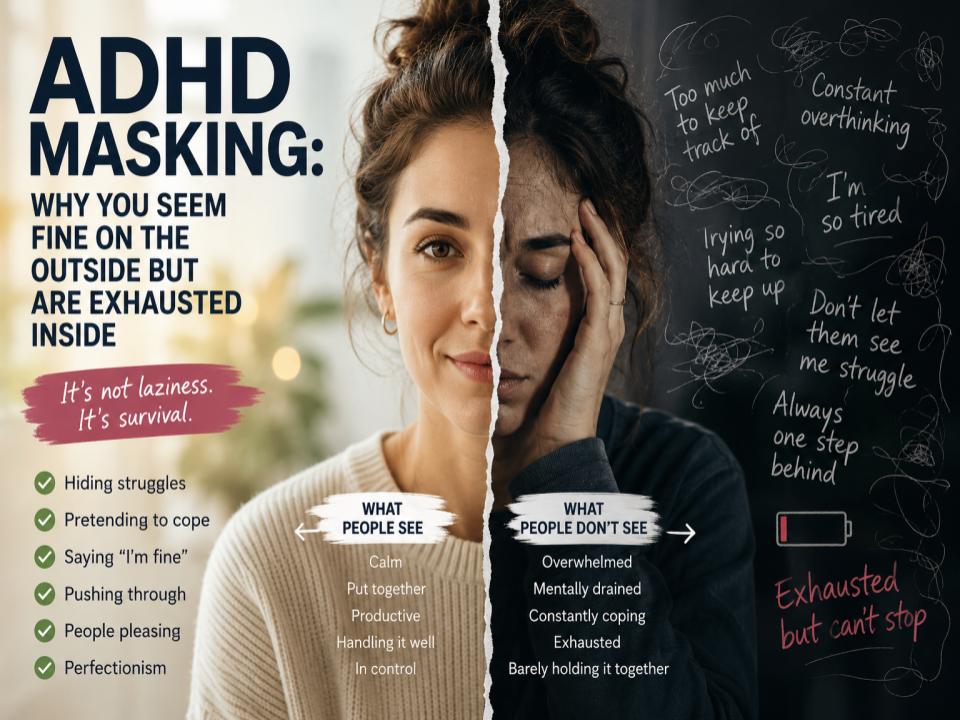
You hold it together at work. You respond to emails on time. You smile at the right moments. To everyone around you, you look perfectly fine.
But the moment you get home, you collapse.
This is ADHD masking. And if it sounds familiar, you are far from alone.
Millions of people with ADHD — especially adults who were never diagnosed as children — spend enormous mental energy hiding their symptoms every single day. They learn to mimic neurotypical behavior so well that even the people closest to them have no idea what is happening beneath the surface. Doctors miss it. Teachers miss it. Family members miss it. Sometimes, people miss it in themselves for decades.
This blog breaks down what ADHD masking actually is, why it happens, who it affects most, and what you can do about it. Whether you are newly diagnosed, still undiagnosed, or supporting someone who is, this guide will help you understand the invisible weight that comes with looking fine on the outside.
What Is ADHD Masking?
ADHD masking — sometimes called camouflaging — is the act of hiding or suppressing ADHD symptoms to fit into social and professional expectations. It is not a conscious choice for most people. It develops over time, often starting in childhood, as a survival response to repeated feedback that your natural behavior is wrong, too much, or disruptive.
When someone masks their ADHD, they might:
- Force themselves to sit still even when every part of their body wants to move
- Script conversations in advance to avoid saying something impulsive
- Write and rewrite emails multiple times to seem organized
- Laugh along in a meeting when they have completely lost track of what is being discussed
- Set dozens of reminders just to appear as if they naturally remember things
- Stare at a speaker intently to fake active listening while their mind drifts
Each of these behaviors takes effort. Real, sustained, exhausting effort. And when that effort is repeated hundreds of times a day, across years of a person’s life, the cost accumulates in ways that are difficult to overstate.
Masking is not the same as managing symptoms. Managing symptoms means developing systems and strategies that genuinely help you function better. Masking means suppressing who you are to avoid judgment. The distinction matters because masking does not make the underlying challenges disappear. It just hides them — from others, and often from yourself.
Learn more about ADHD symptom presentations from the American Psychiatric Association.
Why Do People with ADHD Mask?
Masking is learned. Nobody is born doing it. It develops because the world consistently rewards neurotypical behavior and punishes behavior that looks like ADHD.
From early childhood, many people with ADHD receive a steady stream of criticism. They are told they are lazy, disruptive, dramatic, or careless. They learn very quickly that showing their authentic behavior leads to negative consequences — lower grades, social exclusion, parental frustration, or professional setbacks.
So they adapt. They watch how other people behave. They copy it. They practice it. They internalize the message that who they naturally are is not acceptable, and they build a performance around a more socially acceptable version of themselves.
This process is often entirely unconscious. Children do not decide to mask. They just stop getting in trouble as much when they hold themselves still. They get more praise when they seem to be paying attention. Over years, the mask becomes second nature. By adulthood, many people with ADHD have been masking for so long that they genuinely cannot tell where the mask ends and they begin.
There is also a deep social component to masking. Humans are wired for connection and belonging. When someone learns that their authentic behavior consistently puts belonging at risk, the brain treats suppressing that behavior as a safety strategy. This is particularly true for people who face additional social pressures — women, people of color, LGBTQ+ individuals, and people who grew up in strict or critical environments often mask at higher rates because the stakes of standing out feel higher.
The CDC offers a comprehensive overview of ADHD and its causes.
 Who Masks the Most? The Gender Gap in ADHD Diagnosis
One of the most important and underreported realities of ADHD masking is how differently it affects women and girls compared to men and boys.
For decades, ADHD research was conducted almost entirely on male subjects. The classic image of ADHD — the hyperactive boy who cannot sit still in class — shaped how doctors, teachers, and parents understood the condition. Girls who had ADHD but presented differently were routinely missed.
Girls with ADHD tend to internalize their struggles more. They are more likely to have the inattentive presentation of ADHD, which is less visible. They daydream rather than act out. They lose focus silently rather than disrupting the classroom. They develop social awareness earlier, which helps them mask more effectively. As a result, they get diagnosed at significantly lower rates during childhood.
By adulthood, many women with ADHD have spent 20, 30, or 40 years believing they are simply anxious, disorganized, or not trying hard enough. Their masking is often extraordinarily sophisticated. They have been doing it longer and with higher stakes — in professional environments where women already face more scrutiny, masking becomes a professional necessity that feels inescapable.
Research has consistently found that women with ADHD receive their diagnosis later in life, are more likely to present with anxiety and depression alongside their ADHD, and report higher levels of emotional exhaustion related to masking. This is not because their ADHD is milder. It is often because their mask is more developed.
ADDitude Magazine covers the gender gap in ADHD diagnosis in depth.
This dynamic is also present for people of color, who face additional cultural and systemic barriers to ADHD diagnosis and often mask at higher rates due to the compounding effects of racial bias in medical and educational settings.
The Hidden Cost: What Masking Does to Your Brain and Body
Here is what most people outside the ADHD community do not understand: masking is not free. Every hour you spend performing neurotypicality costs something. And the bill eventually comes due.
Cognitive fatigue is one of the most immediate consequences. The brain has a finite capacity for self-regulation. When someone with ADHD spends their entire workday suppressing impulses, forcing focus, tracking social cues, and carefully managing their presentation, they arrive home with almost nothing left in reserve. The person who was articulate and composed in the office may become unable to make a simple dinner decision. This is not weakness. It is depletion.
Burnout is the longer-term consequence. ADHD burnout is a state of complete mental, emotional, and physical exhaustion that builds up over months or years of sustained masking. It is distinct from general burnout and can be more severe and longer-lasting. People in ADHD burnout often describe losing the ability to do even basic tasks, becoming unable to regulate their emotions, withdrawing socially, and feeling as though they have lost themselves entirely.
Anxiety and depression frequently accompany masking. Living in constant performance mode, always waiting to be “found out,” is chronically stressful. Many people with ADHD develop anxiety disorders not because anxiety is a core feature of their ADHD, but because years of masking have trained their nervous system to be constantly vigilant. Depression often follows the exhaustion and the loss of identity that comes with sustained masking.
Identity confusion is a less-discussed but equally significant cost. When someone has been masking since childhood, they may have very little sense of who they actually are outside of the performance. What do they actually enjoy? How do they actually communicate when they are not managing someone else’s perception? These questions can feel destabilizing, particularly when a late diagnosis forces someone to revisit their entire history through a new lens.
The National Institute of Mental Health has resources on ADHD and co-occurring conditions.
Signs You May Be Masking Your ADHD
Because masking is often unconscious, many people do not recognize that they are doing it. Here are some signs worth reflecting on.
You feel like a completely different person at work versus at home. The composed, organized professional and the exhausted, scattered person who collapses on the couch feel like two separate people — and maintaining the first one costs you everything.
You rehearse conversations before they happen. You script what you are going to say, anticipate responses, and play out scenarios in your head because improvising in real time feels dangerously unpredictable.
You use external systems to appear organized when internally you feel chaotic. Behind the color-coded calendar and the meticulously organized to-do list is someone who is genuinely terrified of forgetting something important and is working three times as hard as peers to maintain the appearance of being on top of things.
You feel relief when plans get canceled. Not because you are antisocial, but because socializing requires sustained masking that takes real energy. Staying home feels like putting down a heavy bag.
You have been told you “seem fine” or “don’t seem like you have ADHD” — and instead of feeling validated, it fills you with a quiet, complicated despair, because being seen as fine is the result of enormous, invisible effort.
You crash after high-performance periods. After a big project, a social event, or an intense week at work, you need significantly more recovery time than your peers seem to need.
CHADD (Children and Adults with ADHD) offers a helpful guide to recognizing ADHD in adults.
 Masking vs. Coping: Understanding the Difference
It is important to draw a clear line between masking and genuine coping strategies, because conflating the two can make recovery harder.
Masking is about hiding who you are from others. The goal is to prevent other people from seeing your ADHD. The effort goes into managing their perception. Masking is external.
Coping is about making life genuinely easier for yourself. It involves accommodations, tools, and strategies that reduce the actual impact of ADHD challenges — not to impress anyone, but because they genuinely help. Coping strategies are internal.
For example: setting reminders to remember an appointment is a coping strategy. Setting reminders and then pretending to your boss that you remembered naturally — because you are afraid of what they will think if they know you need reminders — is masking layered on top of coping.
The goal in ADHD recovery and management is to move away from masking and toward coping. This means building systems that work for your actual brain, rather than systems designed to protect a performance. This shift requires, among other things, reducing the shame that drives the need to mask in the first place.
Understood.org breaks down effective coping strategies for adults with ADHD.
The Role of Shame in Keeping the Mask On
Masking cannot be fully understood without talking about shame. Shame is the engine that powers the mask.
When someone has spent years being told — explicitly or implicitly — that the way their brain works is wrong, they internalize that message. It becomes part of how they see themselves. And because the core self feels unacceptable, they work hard to keep it hidden. The mask is, in many ways, a shame management strategy.
This is why diagnosis alone is not always enough to stop masking. Intellectually understanding that you have ADHD does not immediately undo decades of shame. Many people receive a diagnosis and feel relief for a while, but then continue masking just as intensively — because the fear of being seen is still there, even when the explanation for why they are different has changed.
Reducing masking requires addressing the underlying shame. This often involves therapy, particularly approaches like Cognitive Behavioral Therapy (CBT) and ACT (Acceptance and Commitment Therapy), both of which have solid evidence bases for helping people with ADHD reframe their relationship with their symptoms. It also involves connecting with community — other people with ADHD who openly discuss their experiences — which helps interrupt the isolation and secrecy that shame depends on.
What Unmasking Looks Like (And Why It Feels Scary)
Unmasking does not mean abandoning all coping strategies and announcing your ADHD to everyone you meet. It is a more gradual, personal process of reducing the energy you spend managing other people’s perceptions — and redirecting that energy toward actually living your life.
For many people, unmasking starts with small moments of honesty. Telling a trusted friend or partner what your day actually costs you. Asking for an accommodation at work rather than quietly struggling. Admitting to yourself that you hate the systems you have built for appearances and building ones that actually work for your brain instead.
Unmasking can feel genuinely frightening. The fear is usually some version of: if people see the real me, they will think I am incompetent, lazy, or difficult. This fear often has roots in real experiences of being judged or dismissed. It is not irrational. But it is worth examining, because the alternative — sustained masking — has serious long-term consequences for health, identity, and wellbeing.
Many people who begin unmasking describe an unexpected side effect: they become more effective, not less. When they stop spending so much energy on the performance, they have more available for the actual work. When they stop trying to hide how their brain works, they can build systems that actually match how their brain works. The person underneath the mask is not a liability. They are often creative, energetic, and capable in ways the performance was actively suppressing.
Psychology Today has a useful overview of unmasking and authenticity for neurodivergent people.
How ADHD Masking Shows Up at Work
The workplace is often where masking is most intense — and most costly. Professional environments reward consistency, attention to detail, punctuality, and the appearance of effortless competence. For someone with ADHD, meeting these expectations requires extraordinary effort that most colleagues never see.
Common workplace masking behaviors include:
Arriving early — not because you are naturally prompt, but because you have built in extensive buffer time to account for the chaos that happens when you try to get out the door on a hard timeline.
Over-preparing for meetings, presentations, and phone calls to compensate for the fear that your attention will drift and you will miss something important.
Staying late — not out of dedication, but because it took you significantly longer to complete tasks that require sustained attention, and you need to make up the difference without anyone noticing.
Avoiding certain tasks or projects — not because they are outside your skill set, but because they require the kind of sustained, sequential attention that is genuinely harder for your brain, and you have learned to route around them quietly.
Performing attentiveness in meetings — nodding, making eye contact, taking notes you may or may not refer to later — as a way of covering the fact that your mind has wandered somewhere else entirely.
None of this makes you lazy or dishonest. It makes you someone who has learned to survive in an environment not designed for your brain. But it is exhausting, and it is unsustainable. Many people with ADHD hit a wall at some point in their career where the masking simply stops working — they burn out, miss something important, or find that the coping mechanisms they built for one kind of work do not transfer to a new role or a more demanding environment.
Understanding this pattern is the first step toward addressing it — whether through formal workplace accommodations, structural changes to how you work, or coaching that helps you build systems aligned with your actual strengths.
The Job Accommodation Network (JAN) provides resources on workplace accommodations for ADHD.
 Getting Support: You Do Not Have to Carry This Alone
One of the most important things to understand about ADHD masking is that you do not have to figure this out on your own. And more importantly — the goal is not to mask better. The goal is to need to mask less.
That shift happens through a combination of the right support systems.
Accurate diagnosis is a meaningful first step if you have been struggling without a clear framework for understanding why. A diagnosis does not define you. It gives you language for your experience and opens doors to support that was previously unavailable.
Therapy with a clinician who understands ADHD — especially the emotional and identity-related dimensions of late diagnosis and long-term masking — can be genuinely transformative. Cognitive Behavioral Therapy, ACT, and ADHD-informed therapeutic approaches all have strong evidence behind them. The Association for Contextual Behavioral Science has a therapist directory for ACT-trained clinicians.
Medication, if appropriate, significantly reduces the baseline effort required to manage symptoms for many people — which means less masking is required just to get through the day. This is a conversation to have with a qualified medical professional. CHADD provides a comprehensive overview of ADHD medication options.
Community matters enormously. Connecting with other people who have ADHD — through support groups, online spaces, or social communities — helps reduce the isolation and shame that sustain masking. Hearing other people describe your exact experience with recognition and humor is powerfully validating in a way that information alone cannot replicate.
Coaching is a practical, skills-based form of support that helps people build systems and strategies aligned with how their brain actually works — not systems designed to perform neurotypicality, but systems that genuinely help you get things done, feel less overwhelmed, and live a life that actually fits you. The ADHD Coaches Organization offers resources on finding qualified ADHD coaches.
Conclusion: ADHD Masking — Why You Seem Fine on the Outside But Are Exhausted Inside
ADHD masking — why you seem fine on the outside but are exhausted inside — is one of the most important and underrecognized dimensions of living with ADHD. It is the reason so many people go undiagnosed for decades. It is the reason so many high-functioning adults feel like they are quietly falling apart beneath a composed exterior. And it is the reason that “but you seem so together” can feel less like a compliment and more like confirmation that the performance is working — at tremendous personal cost.
The main takeaway is this: looking fine and being fine are not the same thing. The energy required to appear neurotypical — to suppress, script, compensate, and perform — is real, significant, and cumulative. And the goal is not to mask more effectively. The goal is to build a life where you do not need to hide who you are in order to be accepted and functional.
That starts with understanding what masking is, recognizing it in your own life, and taking steps — however small — toward more authenticity and better-fitting support.
You do not owe anyone a performance of normalcy. You deserve a life that works for your brain.
Ready to stop managing your ADHD alone? If you are ready to get your ADHD in order — to build real systems, reduce the exhaustion, and finally feel like you are working with your brain instead of against it — explore affordable ADHD coaching and take the first step toward a life that actually fits you.