

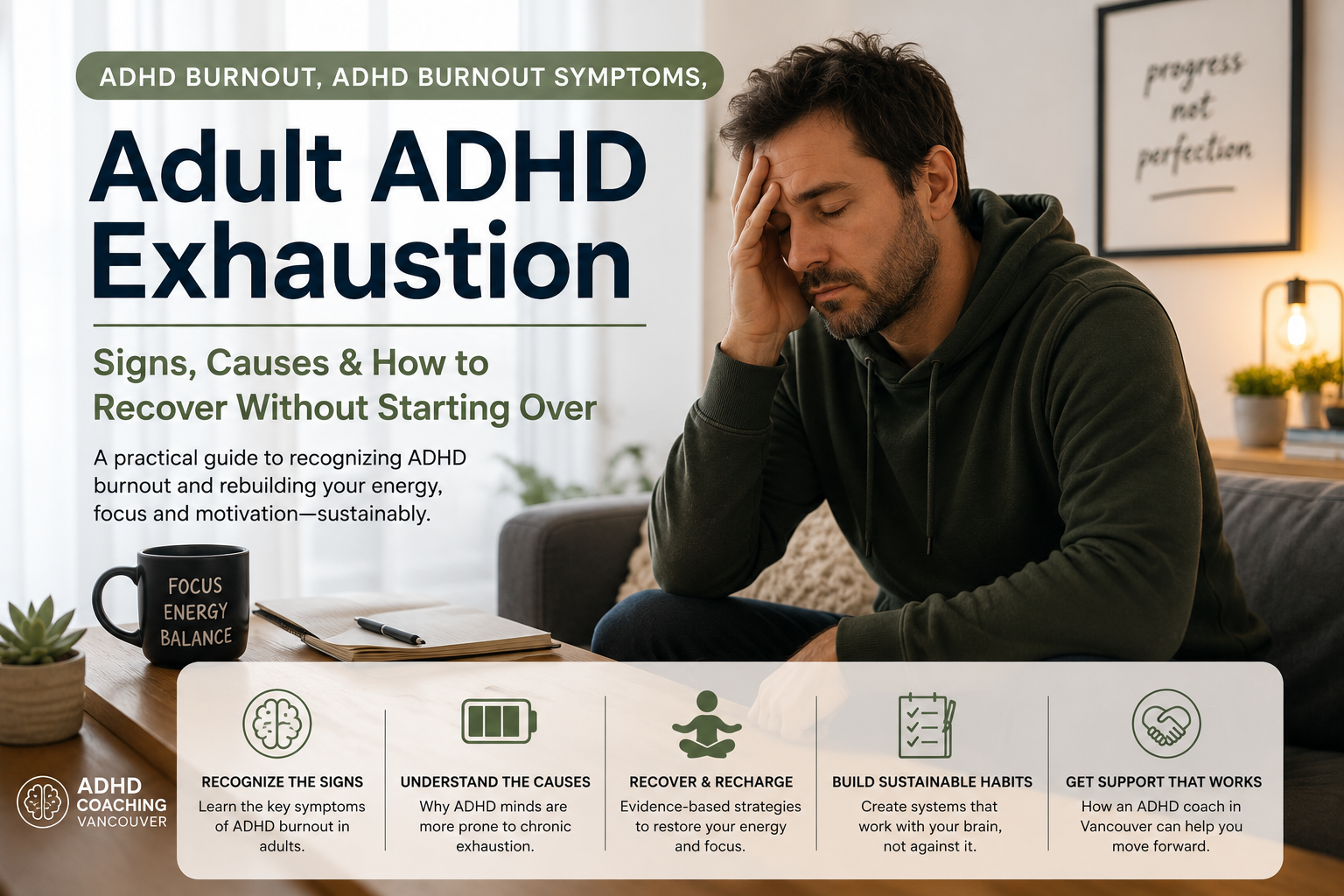
 Understanding ADHD Burnout: Symptoms, Causes, and Recovery for Adults
If you feel wiped out even after a full night’s sleep, if simple tasks feel impossible, and if you’ve stopped recognizing yourself, you may be dealing with ADHD burnout. This isn’t ordinary tiredness. It’s a deeper kind of exhaustion that builds up in people with ADHD after months or years of masking, overcompensating, and pushing through a world that wasn’t built for their brains. This guide explains what ADHD burnout is, how to recognize the symptoms, why adults with ADHD are especially prone to it, and what real recovery looks like.
What Is ADHD Burnout?
ADHD burnout is a state of severe mental, physical, and emotional depletion that happens when someone with ADHD has spent too long compensating for their symptoms without enough rest or support. It’s not an official diagnosis in the DSM-5, but it’s a term widely used by clinicians, coaches, and the ADHD community to describe a very real and consistent experience.
Unlike general burnout, which usually stems from a specific stressor like a demanding job, ADHD burnout often builds slowly and quietly. It comes from the daily effort of managing executive function challenges: remembering appointments, regulating emotions, starting tasks, finishing tasks, filtering distractions, and appearing “normal” in a neurotypical world. Over time, this constant self-management drains the nervous system.
The American Psychiatric Association describes ADHD as a neurodevelopmental disorder that affects attention, impulse control, and activity levels. What it doesn’t fully capture is the cumulative toll of living with these traits every single day, especially for adults who were diagnosed late or never received support growing up. That cumulative toll is what ADHD burnout describes.
Burnout can happen to anyone with ADHD, but it’s especially common in people who mask their symptoms at work or in relationships, perfectionists who overcorrect for their ADHD traits, parents managing a household on top of their own executive function struggles, and people who’ve spent years without a diagnosis or proper support. Understanding this pattern is the first step toward breaking it.
Common ADHD Burnout Symptoms
Recognizing ADHD burnout symptoms early can prevent a full collapse. The signs often overlap with general burnout and depression, which is part of why ADHD burnout gets missed or misdiagnosed. Here’s what it typically looks like.
Physical exhaustion that doesn’t improve with sleep. Many people describe feeling tired no matter how much they rest. This happens because ADHD burnout isn’t just about missing sleep. It’s about the nervous system running in a constant state of overdrive.
Loss of motivation, even for things you used to enjoy. Hobbies, social plans, and goals that once felt exciting start to feel like burdens. This isn’t laziness. It’s a sign that the brain’s reward system is depleted.
Increased forgetfulness and disorganization. Executive function challenges that were manageable before suddenly feel impossible. Missed deadlines, lost items, and forgotten appointments become more frequent.
Emotional dysregulation. Small frustrations trigger big reactions. Irritability, tearfulness, or a short temper often show up during burnout, even in people who normally manage their emotions well.
Increased sensory sensitivity. Noise, light, and clutter that used to be tolerable become overwhelming. This is a common but often overlooked symptom.
Withdrawal from responsibilities and relationships. People in ADHD burnout often cancel plans, avoid emails, and pull away from commitments. This isn’t a lack of care. It’s the brain protecting itself from further depletion.
A sense of failure or shame. Many adults with ADHD burnout describe feeling like they’re “falling apart” or “losing their grip,” which can spiral into negative self-talk and lowered self-esteem.
If several of these symptoms sound familiar and have lasted for weeks or months, it’s worth speaking with a doctor or mental health professional. Burnout can overlap with depression and anxiety, and a proper assessment helps rule out or address those conditions alongside ADHD.
 Adult ADHD Exhaustion: Why It Hits So Hard
Adult ADHD exhaustion is different from the tiredness most people experience. To understand why, it helps to look at how ADHD affects the brain’s regulation systems.
ADHD is linked to differences in the brain’s dopamine and norepinephrine systems, which play a role in motivation, attention, and reward processing. The National Institute of Mental Health notes that ADHD involves patterns of inattention, hyperactivity, and impulsivity that interfere with functioning or development. These aren’t simply behavioral quirks. They reflect real differences in how the brain manages effort and regulation.
For adults with ADHD, this means everyday tasks that seem simple to others, like replying to an email, starting a load of laundry, or sitting through a meeting, require significantly more mental effort. This is sometimes called the “ADHD tax”: the extra cognitive labor needed to do ordinary things. Multiply that tax across a full day, a full week, and a full year, and the exhaustion compounds.
Many adults with ADHD also spend enormous energy on masking, which means hiding or suppressing symptoms to appear more “typical” at work or in social settings. Masking might look like forcing eye contact, rehearsing conversations in advance, or suppressing fidgeting. While it can help someone get through a meeting or a first date, masking is mentally and emotionally costly. Done consistently over years, it’s one of the biggest contributors to burnout.
Late-diagnosed adults are particularly vulnerable. Many spent decades believing they were lazy, careless, or not trying hard enough, without understanding the neurological reason behind their struggles. That history often includes years of overcompensating without support, which sets the stage for deeper exhaustion once the coping strategies stop working.
ADHD Burnout vs. General Burnout: What’s the Difference?
General burnout, as defined by the World Health Organization, results from chronic workplace stress that hasn’t been successfully managed. It’s characterized by exhaustion, cynicism or detachment from one’s job, and reduced professional effectiveness.
ADHD burnout shares those features but has a different root cause and a broader reach. General burnout is usually tied to a specific job or role. ADHD burnout can show up in every area of life at once: work, home, parenting, friendships, and self-care, because the underlying cause is the ongoing management of ADHD symptoms rather than one external stressor.
Another key difference is recovery time. A person with general burnout might recover after a vacation, a job change, or reduced workload. ADHD burnout tends to be more stubborn because the underlying challenge, the ADHD brain itself, doesn’t go away. Without new systems, support, or strategies in place, the same patterns that led to burnout the first time will likely lead to it again.
There’s also a difference in root triggers. General burnout is often about too much work. ADHD burnout is often about too much friction in ordinary tasks, compounded by masking, shame, and inconsistent executive function. Someone with ADHD can burn out from a completely reasonable workload if that workload requires constant organization, time management, and self-monitoring without accommodations or support.
Understanding this distinction matters because the standard advice for burnout, like “take a break” or “set better boundaries,” often isn’t enough on its own for someone with ADHD. Recovery usually needs to address the ADHD itself, not just the stress layered on top of it.
What Causes ADHD Burnout to Build Up Over Time
ADHD burnout rarely appears overnight. It usually accumulates through a combination of the following factors.
Chronic masking. As mentioned earlier, hiding ADHD traits to fit in at work or socially takes constant mental energy. Over months and years, this adds up to significant fatigue.
Perfectionism as a coping mechanism. Many adults with ADHD develop perfectionism to compensate for inconsistency in other areas. Triple-checking work, over-preparing for meetings, or refusing to delegate can create exhausting overwork.
Poor sleep patterns. ADHD is strongly associated with sleep difficulties, including delayed sleep onset and inconsistent sleep schedules. The Sleep Foundation notes that ADHD is linked to a higher prevalence of sleep problems, which in turn worsens attention and emotional regulation, creating a difficult cycle.
Lack of accommodations or support. Many adults with ADHD go without workplace accommodations, therapy, coaching, or medication, either because they’re undiagnosed or because they don’t know what support is available. Without these supports, they’re left to manage symptoms entirely through willpower, which is unsustainable long term.
Life transitions and increased responsibility. New jobs, parenthood, moving, or caregiving responsibilities add layers of executive function demand. These transitions often expose gaps in someone’s coping systems that were previously hidden.
Rejection sensitivity and shame cycles. Many people with ADHD experience heightened sensitivity to criticism or perceived failure. This can lead to overworking to avoid disappointing others, followed by crashes when the effort becomes unsustainable.
Recognizing these root causes is important because addressing burnout only at the surface level, through rest alone, won’t resolve the underlying patterns that caused it.
 ADHD Burnout Recovery: What Actually Helps
ADHD burnout recovery is possible, but it usually requires more than a weekend off. Real recovery tends to involve rebuilding systems, lowering unsustainable expectations, and getting the right kind of support. Here’s what tends to help.
Start with medical and mental health support. A conversation with a doctor or psychiatrist can rule out other conditions, like depression, anxiety, thyroid issues, or sleep disorders, that can mimic or worsen burnout. If ADHD medication is an option and hasn’t been tried, it’s worth discussing with a prescriber, since it can reduce the daily effort needed to manage symptoms. The CDC outlines that ADHD treatment often combines behavioral strategies, therapy, and, when appropriate, medication.
Reduce the load before adding anything new. Before trying new productivity systems, look at what can be removed. This might mean saying no to new commitments, delegating tasks, or dropping non-essential obligations for a period of time. Recovery isn’t about doing more, better. It’s about doing less, more sustainably.
Rebuild basic routines gently. Sleep, meals, movement, and hydration often fall apart during burnout. Rather than overhauling everything at once, focus on one or two small, consistent routines. Small wins rebuild a sense of stability.
Address shame directly. Burnout often comes with a heavy layer of self-blame. Reframing the experience as a predictable result of unmanaged ADHD, rather than a personal failure, is a crucial mental shift. Therapy, especially with a clinician familiar with ADHD, can help with this.
Rebuild slowly and expect setbacks. Recovery isn’t linear. There will be good weeks and hard weeks. The goal isn’t to never struggle again. It’s to build systems that make struggles less frequent and less severe.
Practical Strategies to Prevent Future Burnout
Once the acute exhaustion starts to ease, the focus shifts to prevention. These strategies help reduce the risk of falling back into burnout.
Build in recovery time, not just productive time. Many adults with ADHD schedule their days around tasks and deadlines but forget to schedule rest. Treating downtime as a non-negotiable part of the day, not an afterthought, helps prevent the buildup that leads to burnout.
Use external systems instead of relying on memory. Calendars, reminders, and visual to-do lists reduce the cognitive load of trying to remember everything internally. The goal is to offload mental effort onto tools, not to rely on willpower.
Set realistic, not idealistic, expectations. Many adults with ADHD hold themselves to standards that don’t account for how their brain actually works. Adjusting expectations to match reality, rather than an idealized version of productivity, reduces the pressure that fuels burnout.
Reduce masking where it’s safe to do so. This might mean being more open about ADHD with trusted friends, family, or coworkers, or simply allowing yourself to fidget, take breaks, or work in ways that suit your brain rather than forcing conformity.
Build a support network. This can include a therapist, a psychiatrist, a support group, or an ADHD coach. Recovery and prevention are much harder to sustain alone.
Track patterns, not just tasks. Paying attention to what precedes a burnout episode, whether it’s poor sleep, overcommitment, or unmanaged stress, helps identify personal warning signs early, before exhaustion becomes severe.
 When to Consider Working with an ADHD Coach
For many adults, especially those managing ADHD burnout on top of work, parenting, or other responsibilities, professional support makes a meaningful difference. This is where an ADHD coach can help.
Unlike therapy, which often focuses on emotional processing, ADHD coaching is practical and forward-focused. A coach helps build systems for time management, task initiation, organization, and follow-through, tailored specifically to how an ADHD brain works. This kind of individualized, structured support is often exactly what’s missing for adults who’ve been trying to manage everything through sheer effort.
Coaching is particularly useful during and after burnout because it helps rebuild sustainable habits without falling back into the same patterns that caused the exhaustion in the first place. A good coach won’t just hand over generic productivity tips. They’ll help identify the specific triggers, patterns, and barriers unique to the individual, and build a plan around them.
For people in British Columbia looking for accessible, local support, working with an ADHD coach Vancouver residents can meet with, whether in person or virtually, offers the added benefit of understanding regional resources, healthcare pathways, and community support options. Combining coaching with medical care, and where needed, therapy, creates a more complete support system than trying to manage ADHD burnout alone.
Conclusion: Understanding ADHD Burnout, Symptoms, and Recovery for Adults
ADHD burnout is real, common, and deeply exhausting, but it’s not permanent. Recognizing the symptoms early, from physical exhaustion and emotional dysregulation to disorganization and withdrawal, makes it possible to intervene before things get worse. Adults with ADHD face unique challenges that make them especially vulnerable to this kind of deep fatigue, largely due to masking, unmanaged executive function demands, and years of trying to cope without proper support.
The good news is that recovery is achievable. It starts with reducing the load, addressing shame, rebuilding routines gently, and getting the right support in place, whether that’s medical care, therapy, or coaching. Understanding ADHD Burnout: Symptoms, Causes, and Recovery for Adults isn’t just about naming the problem. It’s about recognizing that sustainable change is possible with the right tools and the right people in your corner.
If you’re ready to get your ADHD in order, check out affordable ADHD coaching to build a plan that actually works for your brain. Support that understands how ADHD works can make all the difference between cycling through burnout again and building a life that feels sustainable.