
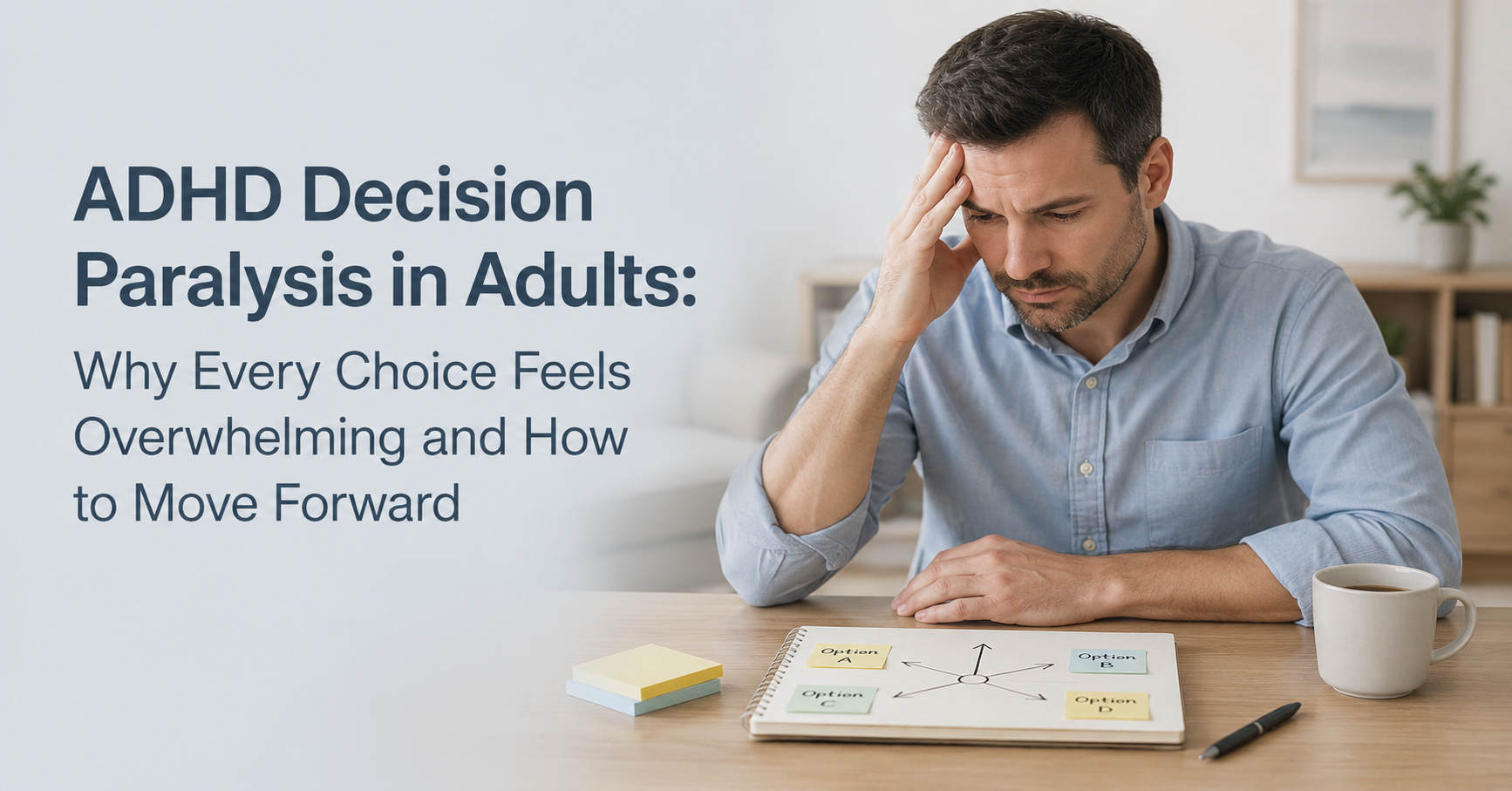
 ADHD Decision Paralysis in Adults: Why Every Choice Feels Overwhelming and How to Move Forward
You stand in the cereal aisle for ten minutes. You reread the same email three times before hitting send. You cannot decide what to make for dinner, so you order the same takeout again. If this sounds familiar, you are not lazy, and you are not broken. You may be experiencing ADHD decision paralysis, a well-documented pattern where the ADHD brain gets stuck between options instead of moving toward a choice.
This article explains why decision paralysis happens in adults with ADHD, what is going on in the brain, and how to build practical systems that make choosing easier. You will also find real strategies you can use today, not just theory.
Many adults with ADHD spend years thinking their indecision is a personal weakness. They compare themselves to friends and coworkers who seem to breeze through choices, and they wonder why something so ordinary feels so hard. This comparison often leads to shame, and shame rarely helps anyone make better decisions. It usually makes the freeze worse, because now there is an added layer of self-judgment sitting on top of the original problem.
The good news is that decision paralysis has been studied, named, and linked directly to how ADHD affects the brain. That means it is not a mystery, and it is not something you have to solve through sheer willpower. It responds to structure, to specific techniques, and in many cases, to professional support. This article walks through all three.
What Is ADHD Decision Paralysis?
Decision paralysis is the experience of freezing when faced with a choice, even a small one. For adults with ADHD, this freeze response shows up constantly. It can strike over which shirt to wear, which project to start first, or which career path to pursue.
This is not simple indecisiveness. A person without ADHD might weigh pros and cons and settle on an answer within a few minutes. A person with ADHD often gets stuck in a loop. The brain pulls up every possible option at once, weighs them all with equal intensity, and never lands on a clear winner. A 2025 study on adults with ADHD found that 82% reported frequent difficulties with decision-making, and 68% said this paralysis significantly affected their work performance (NCBI, 2025).
This matters because decision paralysis is not a character flaw. It is a recognized effect of how ADHD changes brain function. Once you understand that the struggle has a name and a cause, it becomes much easier to build strategies around it instead of blaming yourself for it.
Decision paralysis also tends to compound. One unmade decision often blocks several others behind it. If you cannot decide what to eat, you cannot decide when to go to the gym. If you cannot decide which task to start, your whole afternoon can dissolve into scrolling instead of working. Recognizing this chain reaction is the first step toward interrupting it.
It helps to distinguish decision paralysis from simple procrastination. Procrastination often involves avoiding a task you know how to do but do not feel like doing. Decision paralysis is different. It happens even when you want to act and even when the choice matters to you. The blockage is not motivation. It is the mechanical process of narrowing options down to one. This distinction matters because the fixes for procrastination, like willpower or discipline, rarely work for decision paralysis. What works instead is reducing the number of comparisons your brain has to run.
Decision paralysis can also look different from person to person. Some people freeze visibly, sitting motionless in front of a menu or a form. Others mask it by making a snap decision just to escape the discomfort, only to regret the choice minutes later. Both patterns come from the same underlying struggle: the brain cannot comfortably hold and compare multiple options long enough to land on one with confidence.
 Why the ADHD Brain Struggles With Choices
ADHD is not just about attention. It is fundamentally a disorder of executive function, the set of mental skills that let you plan, prioritize, and follow through on a decision. The Centers for Disease Control and Prevention notes that ADHD symptoms often become more noticeable in adulthood, when the demands of work, finances, and family increase (CDC, ADHD in Adults).
Executive function includes skills like working memory, impulse control, emotional regulation, and the ability to weigh short-term versus long-term outcomes. CHADD, the National Resource Center on ADHD, describes executive function as the set of brain functions that let a person plan for the consequences of their actions and adjust course in real time (CHADD, Executive Function Skills). When these functions are impaired, every decision demands more mental energy than it should.
Research backs this up directly. A study published in the Journal of the International Neuropsychological Society concluded that ADHD is associated with impaired decision-making specifically in tasks that require a high degree of cognitive control (PubMed, 2010). In plain terms, the more a decision requires sustained focus and weighing of consequences, the harder it becomes for an ADHD brain to complete it smoothly.
There is also a dopamine piece to this puzzle. Dopamine helps the brain register a sense of reward and motivation. ADHD brains tend to run lower on dopamine regulation, which can make ordinary decisions feel flat or unrewarding. Without a strong internal signal telling you “this is the right choice,” every option can feel equally unappealing or equally interesting, and the brain has no natural tiebreaker.
Working memory adds another layer. Working memory is what lets you hold multiple options in your head at once and compare them. When working memory is taxed, as it often is in ADHD, you may forget the pros of an option you considered two minutes ago, forcing you to restart the comparison. This is exhausting, and it is a major reason why decisions that seem simple to other people can feel enormous to you.
Emotional regulation plays a role too. ADHD often comes with more intense emotional responses to everyday events, including the fear of choosing wrong. The ADDA notes that executive dysfunction can involve difficulty managing emotions alongside impulsive decision-making and trouble with task-switching (ADDA, Executive Function Disorder). When a decision carries even a small emotional charge, whether it is fear of regret or fear of judgment, that charge can be enough to stall the entire process. The brain essentially treats a low-stakes choice with the same alarm it might reserve for a genuinely risky one.
It is also worth noting that ADHD brains often show a preference for immediate, tangible rewards over long-term, abstract ones. This is sometimes called delay aversion. When a decision involves weighing a small reward now against a bigger reward later, the ADHD brain can struggle to give proper weight to the future option, which adds another layer of difficulty to choices like saving money, choosing a long-term career path, or picking a healthier habit over a more convenient one.
Common Triggers That Make Decision Paralysis Worse
Certain situations reliably make ADHD decision paralysis worse. Recognizing your personal triggers helps you plan around them instead of getting caught off guard.
Too many options at once. Choice overload is a well-studied phenomenon in psychology, and it hits ADHD brains especially hard. A restaurant menu with sixty items, a streaming service with thousands of shows, or a job board with hundreds of listings can all trigger a shutdown. The brain tries to evaluate everything simultaneously and stalls.
Fear of making the wrong choice. Many adults with ADHD carry years of criticism for missed deadlines, forgotten commitments, or impulsive decisions that did not work out. This history can create a heightened fear of getting it wrong again, which turns a simple choice into a high-stakes event.
Low energy or high stress. Executive function is not a fixed resource. It fluctuates with sleep, stress, hunger, and overall mental load. A decision that feels manageable in the morning can feel impossible by evening, once the day’s demands have drained your capacity.
Perfectionism. Some adults with ADHD develop perfectionist tendencies as a coping mechanism, often because past mistakes felt costly. Wanting the perfect answer instead of a good enough answer can keep a decision open indefinitely.
Unclear priorities. When everything feels equally urgent, nothing gets chosen first. ADHD can make it hard to rank tasks by true importance, so a low-stakes email and a major deadline can compete for attention on equal footing.
Understanding which of these apply to you is useful. It lets you match the right strategy to the right problem instead of applying a generic fix that does not address your specific pattern.
The Real-Life Impact of Chronic Indecision
Decision paralysis does not stay contained to small moments. Over time, it touches nearly every part of daily life, and the cumulative effect can be significant.
At work, unmade decisions pile up into missed deadlines, unanswered emails, and a growing sense of falling behind. Colleagues may misread the delay as a lack of care or competence, when in fact the person is often working hard just to arrive at a decision. This mismatch between effort and outcome can be one of the most frustrating parts of adult ADHD.
In relationships, chronic indecision can create friction. A partner may grow tired of being the one who always picks the restaurant or plans the trip. Over time, this imbalance can breed resentment on both sides, even though neither person intends harm.
Financially, decision paralysis can lead to avoidance. Choosing a budget, comparing insurance plans, or picking an investment option all require sustained comparison, which is exactly the kind of task ADHD makes difficult. Avoidance often means bills go unpaid a little longer than they should, or the same suboptimal financial choice gets renewed automatically because changing it feels too hard.
Emotionally, the weight of constant unmade decisions contributes to shame and self-criticism. Executive dysfunction is linked to low motivation and difficulty with planning and organizing, according to the Attention Deficit Disorder Association (ADDA, Executive Function Disorder), and living with this daily can wear down self-esteem over time, especially when a person does not yet understand that ADHD is the underlying cause.
None of this means the situation is hopeless. It means the stakes are real, and building better decision-making systems is not a small quality-of-life improvement. It can meaningfully change how work, relationships, and finances unfold.
 Practical Strategies to Break Through Decision Paralysis
The goal is not to eliminate every hard decision. The goal is to reduce the number of decisions that require full mental effort, so your brain has energy left for the ones that actually matter.
Shrink the number of options. Before choosing, cut the list down to two or three realistic candidates. If you are picking a restaurant, do not browse an entire delivery app. Pick two options ahead of time and choose between only those. Fewer options mean less comparison, and less comparison means less freeze.
Set a decision deadline. Give yourself a fixed, short window, such as two minutes for a small choice or one day for a bigger one. When the timer runs out, you commit to whatever option you are leaning toward. This works because it removes the option to keep circling indefinitely.
Use “good enough” as the standard. Perfection is rarely required. Ask yourself whether an option meets the actual need, not whether it is the theoretical best choice available. Creating checklists or schedules for challenging activities, and preparing decisions the night before, are strategies commonly recommended to reduce the daily decision-making load for people with ADHD (Medical News Today, ADHD and Executive Function).
Automate recurring decisions. Repeat the same breakfast most weekdays. Wear a simplified wardrobe rotation. Set bills to autopay. Every decision you remove from your day is mental energy saved for choices that genuinely need your attention.
Externalize the decision. Write the options down on paper instead of holding them in your head. This reduces the working memory load and lets you see the comparison instead of trying to juggle it mentally.
Ask for a second opinion, briefly. Sometimes hearing someone else say “I’d pick B” is enough to break the loop, even if you do not fully agree. You are not outsourcing your judgment. You are borrowing a tiebreaker.
Build in movement. Physical movement, even a short walk, can help reset a stuck mental loop. Stepping away from the decision for a few minutes often makes the answer clearer when you return.
Track patterns over time. Keep a simple note of decisions that took unusually long. Over weeks, patterns emerge, showing you exactly which categories of choice trip you up most, so you can target those areas specifically.
When to Seek Professional Support
Self-guided strategies help many adults, but some situations call for outside support. If decision paralysis is affecting your job performance, your relationships, or your ability to manage finances and health, it is worth talking to a professional.
A diagnosis, if you do not already have one, can be a meaningful turning point. The National Institute of Mental Health notes that ADHD symptoms must begin in childhood, though many adults are diagnosed later in life once adult responsibilities expose symptoms that were previously masked or overlooked (NIMH, Attention-Deficit/Hyperactivity Disorder). Understanding your own brain gives context to struggles that may have felt confusing or shameful for years.
Treatment can include medication, therapy, or coaching, and these approaches often work best in combination. The Attention Deficit Disorder Association states that with proper support and treatment, adults with executive dysfunction can often overcome these challenges and reach their daily goals (ADDA, Executive Function Disorder). This is an important point: decision paralysis is treatable, not permanent.
ADHD coaching in particular focuses on building the exact kind of practical, personalized systems described in this article. A coach works with you to identify your specific triggers, build routines around them, and hold you accountable as new habits take hold. This is different from therapy, which often addresses emotional processing, and different from medication, which addresses brain chemistry. Coaching addresses the day-to-day mechanics of getting things done.
If you are unsure where to start, a conversation with your family doctor is a reasonable first step. They can help rule out overlapping conditions like anxiety or depression, which can also cause indecision, and refer you to appropriate specialists if needed.
 Building Long-Term Systems That Actually Stick
Quick fixes help in the moment, but lasting change comes from systems built around how your brain actually works, not how you wish it worked.
Start by accepting that decision fatigue is real and cumulative. Schedule your hardest decisions for the time of day when your energy and focus are strongest. For many people with ADHD, this is earlier in the day, before the demands of work and life have drained their executive function reserves.
Build routines that remove decisions entirely wherever possible. A consistent morning routine, a repeating grocery list, or a fixed weekly schedule for recurring tasks all reduce the number of times your brain has to start from zero. The fewer decisions you make on autopilot topics, the more capacity you preserve for decisions that truly require thought.
Give yourself permission to make imperfect choices. Many adults with ADHD hold themselves to an unrealistic standard, believing every decision must be optimal. Letting go of this standard, even slightly, frees up enormous mental space. A reasonable decision made quickly is almost always more valuable than a perfect decision made too late or never made at all.
Finally, track your wins. When you make a decision quickly and it turns out fine, notice it. Over time, this rebuilds trust in your own judgment, which is often eroded after years of struggling with choices. That trust is not just a nice feeling. It is functional. It is what lets your brain move faster the next time a decision comes around, because it has evidence that quick decisions can work out.
It also helps to involve the people around you in your systems. Tell a partner, roommate, or close friend that you are working on reducing decision fatigue, and ask them to help by offering a short list of options instead of open-ended questions. Instead of “what do you want to do this weekend,” a narrowed question like “do you want to hike or see a movie” is far easier for an ADHD brain to answer. Small adjustments like this, repeated across many small interactions, add up to a much lighter daily mental load.
Environment matters as well. A cluttered kitchen makes meal decisions harder. An overflowing inbox makes it harder to decide what to respond to first. Simplifying your physical and digital surroundings removes visual noise that otherwise competes for attention during a decision. This is not about achieving a perfectly organized life. It is about removing enough clutter that your brain has fewer competing signals to sort through when it is already working hard to choose.
Conclusion: Moving Forward From ADHD Decision Paralysis in Adults
ADHD Decision Paralysis in Adults: Why Every Choice Feels Overwhelming and How to Move Forward is not a life sentence. It is a well-documented pattern rooted in executive function differences, and it responds well to practical strategies. Shrinking your options, setting decision deadlines, automating routine choices, and building supportive systems can all reduce the daily weight of constant decision-making. When self-guided strategies are not enough, professional support, including ADHD coaching, can help you build a personalized plan that actually fits your brain.
The key takeaway is simple: your struggle with decisions is not a personal failing. It is a known effect of ADHD, and it is manageable with the right tools and support.
If you’re ready to get your ADHD in order, check out affordable ADHD coaching to build a system that works for your brain, not against it.