

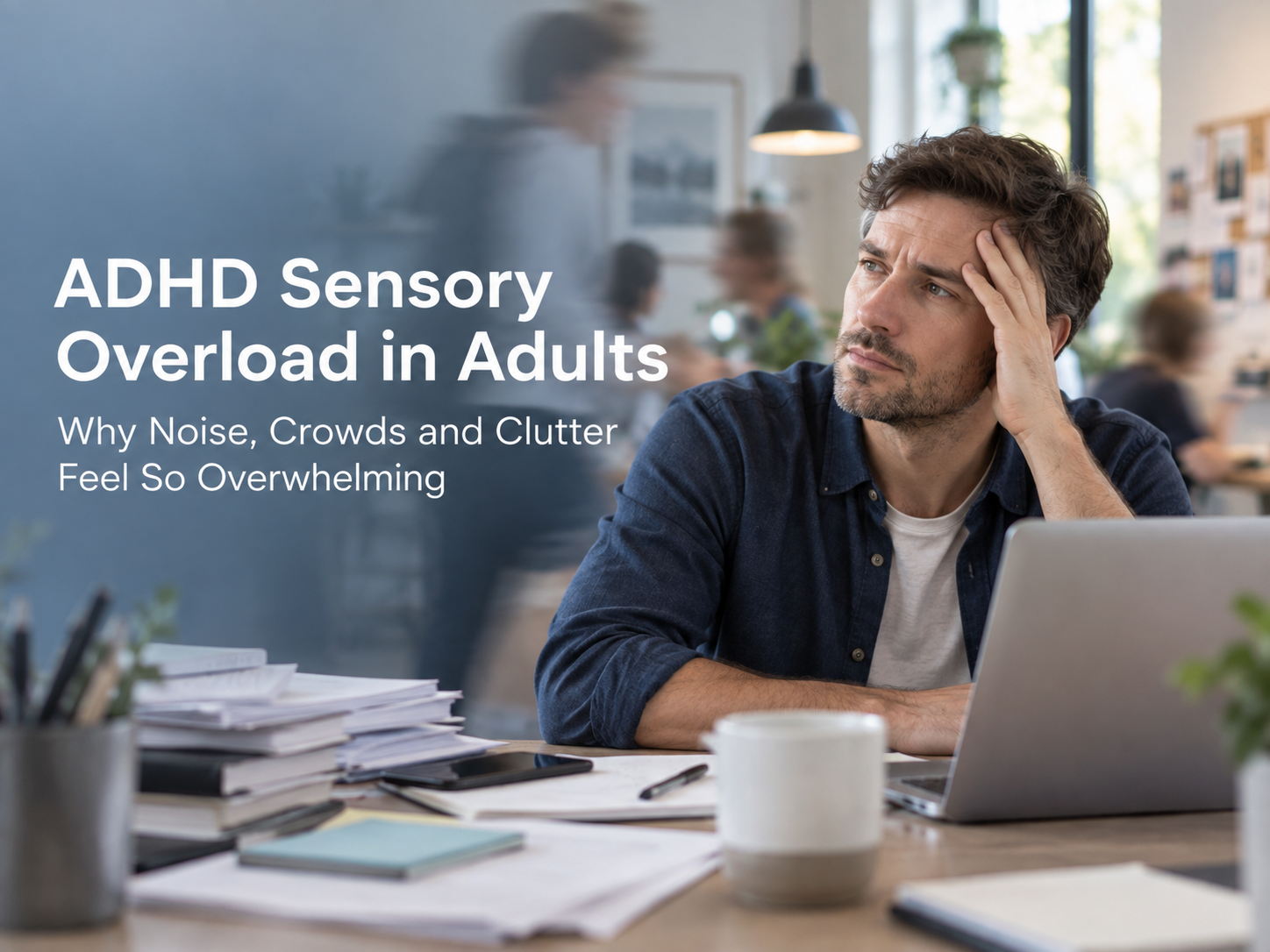
 ADHD Sensory Overload in Adults: Why Noise, Crowds and Clutter Feel So Overwhelming
You walk into a busy grocery store. The lights buzz. A cart squeaks somewhere behind you. Someone’s cart bumps yours. A child cries two aisles over. Within minutes, your chest tightens and your thoughts scatter. You just want to leave.
If this sounds familiar, you are not being “too sensitive.” You are likely experiencing sensory overload, and for adults with ADHD, this experience is common, real, and rooted in how the brain filters information.
This article explains why noise, crowds, and clutter feel so overwhelming for adults with ADHD. It covers the science behind sensory overload, the everyday triggers that set it off, and practical strategies that actually help. If you have ever wondered why a “normal” environment leaves you drained, this is for you.
What Sensory Overload Actually Means
Sensory overload happens when your brain receives more sensory input than it can process at once. Sounds, sights, smells, textures, and movement all compete for attention. In a typical brain, background filtering happens automatically. Irrelevant details fade. Important details stand out.
For adults with ADHD, that filtering system works differently. Instead of quietly muting the hum of a refrigerator or the flicker of fluorescent lights, the ADHD brain often treats every input as equally important. Nothing fades into the background. Everything competes for attention at the same volume.
This is not a matter of willpower. It is a difference in neural filtering, and it directly affects daily functioning. A quick trip to buy milk can feel like standing in the middle of a construction site. A open-plan office can feel like trying to think inside a drum.
Sensory overload is not unique to ADHD. It also appears in autism and sensory processing disorder, and researchers increasingly view sensory sensitivity as a spectrum that cuts across several conditions rather than a single diagnostic marker. The Cleveland Clinic describes sensory processing challenges as difficulty organizing and responding to information taken in through the senses, a description that fits many ADHD experiences closely.
Understanding this distinction matters. Sensory overload is a real physiological event, not an emotional overreaction. Naming it accurately is the first step toward managing it.
The ADHD Brain and Sensory Filtering
To understand why noise, crowds, and clutter feel so intense, it helps to look at what ADHD actually changes in the brain. ADHD affects executive function, which includes attention regulation, working memory, and impulse control. These same systems also help regulate sensory input.
The brain’s ability to filter stimuli relies partly on the prefrontal cortex, the region responsible for prioritizing information. In ADHD, this region often shows differences in activity and connectivity. According to the National Institute of Mental Health, ADHD is associated with differences in brain development and activity that affect attention, impulse control, and self-regulation.
When filtering weakens, the brain cannot easily decide what to ignore. A ticking clock, a flickering screen, and a conversation across the room all arrive with similar urgency. The result is mental noise on top of actual noise.
Dopamine also plays a role. ADHD brains often have lower baseline dopamine activity, which affects motivation and reward processing. Some researchers believe this also affects how intensely the brain reacts to stimulation, since dopamine helps regulate arousal levels. Low baseline dopamine may push the brain toward seeking or reacting strongly to sensory input, which can tip quickly into overload once input becomes excessive.
This combination, weaker filtering plus altered arousal regulation, explains why environments other people barely notice can feel unbearable to someone with ADHD. It is not exaggeration. It is a different sensory operating system.
Why Noise Feels So Loud
Noise is one of the most common triggers for adults with ADHD. Overlapping sounds are especially difficult because the ADHD brain struggles to isolate one sound from many. This is sometimes called poor “auditory figure-ground” processing. In a quiet room, a single conversation is easy to follow. In a noisy restaurant, the same conversation competes with clattering dishes, background music, and nearby chatter, and following it becomes exhausting.
For many adults with ADHD, this is not a minor annoyance. It can cause real fatigue. Constantly working to separate relevant sound from irrelevant sound uses mental energy that other people do not have to spend. By the end of a loud meeting or a noisy commute, that effort adds up.
Unpredictable noise tends to be worse than steady noise. A dripping tap, a phone buzzing intermittently, or a coworker tapping a pen can be more distracting than constant traffic outside a window, because the brain keeps re-checking each new sound for importance. This constant re-evaluation is tiring in a way that is hard to explain to someone who does not experience it.
Sound sensitivity in ADHD sometimes overlaps with a related condition called misophonia, a strong emotional reaction to specific sounds like chewing or tapping. While misophonia is a separate diagnosis, its overlap with ADHD is well documented in clinical literature, and many adults with ADHD report both experiences together.
Recognizing noise sensitivity as a real neurological pattern, not a personality flaw, allows adults to plan around it instead of feeling guilty for needing quiet.
Why Crowds Are Draining
Crowded spaces multiply sensory input in every direction at once. Movement, noise, and closeness all combine, and the ADHD brain has to track far more variables than it can comfortably handle. This is why a busy mall, an airport, or a packed subway car can feel disproportionately stressful.
Part of the difficulty comes from unpredictability. Crowds move in ways that cannot be fully anticipated. Someone might stop suddenly. A stroller might cut across a path. Each of these small surprises demands a fresh burst of attention. For a brain that already struggles to filter and prioritize, this constant stream of micro-decisions is draining.
Social processing adds another layer. Crowds usually involve some degree of social awareness, reading body language, avoiding collisions, responding to greetings, even in silence. ADHD affects working memory, which is also used to track social cues in real time. When working memory is already stretched by sensory input, social processing becomes harder too, which can make crowded social events feel doubly exhausting.
Many adults describe a specific pattern after time in a crowd: irritability, a sudden need to leave, or a “crash” once they get home. This is not rudeness or lack of interest. It is the nervous system recovering from prolonged overstimulation. Recognizing this pattern helps adults plan recovery time after unavoidable crowded events, such as conferences, holidays, or family gatherings, rather than pushing through and burning out.
Understanding this reaction as physiological, rather than social failure, reduces shame and allows for better planning.
 Why Clutter Feels So Heavy
Clutter is a visual form of sensory overload, and it affects ADHD brains in a way that is easy to underestimate. Every object in a cluttered room represents a small decision: keep it, move it, use it, or ignore it. A tidy desk requires almost no decisions. A messy desk requires dozens, even if none of them are ever consciously made.
Because ADHD affects executive function, particularly the ability to filter and prioritize, clutter is not just visually messy. It is cognitively loud. Papers, unfinished projects, cords, and unopened mail all compete for attention, similar to overlapping conversations in a noisy room. The brain cannot simply “look past” the mess the way a neurotypical brain often can.
This helps explain a pattern many adults with ADHD recognize: cleaning starts easily, but finishing feels almost impossible. Each item triggers a new micro-decision, and each decision drains a small amount of mental energy. Multiply that across a cluttered room, and the task becomes far more taxing than it looks from the outside.
Clutter also interacts with working memory. Visual clutter competes with the mental “workspace” used to hold thoughts, plans, and reminders. Some research on visual attention suggests that busy environments reduce task performance and increase distractibility, an effect likely amplified in ADHD brains that already have weaker filtering systems.
This is why many productivity and organization approaches, including advice from Harvard Health Publishing, emphasize simplifying visual environments as a practical way to support focus, not just tidiness for its own sake.
Sensory Overload vs. Anxiety: Knowing the Difference
Sensory overload and anxiety often look similar from the outside, and they frequently occur together. But they are not the same experience, and understanding the difference matters for finding the right coping strategy.
Anxiety is primarily a response to perceived threat or worry. It often involves anticipating a future problem, dwelling on past mistakes, or fearing judgment. Anxiety can occur in a perfectly quiet, calm room with no sensory input at all.
Sensory overload, by contrast, is a direct physiological reaction to the environment itself. It is triggered by the amount and intensity of sensory input, not by a specific worry or fear. A person can feel calm emotionally and still experience sensory overload simply from being in a loud, crowded, or visually chaotic space.
The two can also feed each other. Sensory overload can trigger anxiety, especially if a person fears losing control or being judged for needing to leave a situation. Anxiety, in turn, can heighten sensory sensitivity, making noise and clutter feel even more intense. This overlap is one reason ADHD, anxiety, and sensory sensitivity so often appear together in adults.
Learning to tell the two apart, asking “is this about the environment or about a worry,” helps identify the right response. Removing sensory input helps overload. Addressing the underlying worry helps anxiety. Adults who understand this difference can respond more effectively instead of treating every overwhelmed moment the same way.
Common Everyday Triggers Adults Overlook
Sensory overload does not only happen in obviously loud or crowded places. Many everyday environments quietly accumulate sensory load without adults realizing it until they feel exhausted or irritable.
Open-plan offices are a frequent trigger. Constant movement, overlapping conversations, and unpredictable interruptions create a low hum of sensory demand throughout the workday. Fluorescent lighting adds to this, since flickering or humming lights are a common but underrated stressor for ADHD brains.
Digital environments count too. Multiple browser tabs, constant notifications, and cluttered desktops create visual and cognitive noise, even though nothing is physically loud. Many adults report feeling mentally “full” after a day of screen-based multitasking, without connecting it to sensory overload.
Grocery stores combine several triggers at once: bright lighting, overlapping announcements, crowded aisles, and constant decision-making about products. This combination explains why a “simple errand” can feel disproportionately draining.
Family gatherings and social events often combine noise, crowding, and social processing demands simultaneously. Adults may feel fine for the first hour, then experience a sudden drop in tolerance as sensory input accumulates.
Even clothing textures, tags, seams, or restrictive fabric, can contribute to overall sensory load throughout the day, adding a steady low-level irritation that compounds with other triggers.
Recognizing these overlooked sources helps adults understand why they feel “randomly” overwhelmed on some days, even when nothing dramatic happened. Sensory load builds gradually, and small triggers add up.
Recognizing the Signs in Yourself
Sensory overload often shows up before a person consciously identifies it as such. Learning to recognize early signs makes it easier to intervene before reaching a full shutdown or meltdown.
Physical signs often appear first: a tightening chest, a racing heart, shallow breathing, or a sudden headache. Some adults notice their hearing seems to “sharpen” uncomfortably, as if every sound becomes louder at once.
Cognitive signs follow closely. Thoughts may feel scattered or foggy. Simple decisions, like choosing what to order at a restaurant, suddenly feel impossible. Words may be harder to find mid-sentence.
Emotional signs are often the most noticeable to others. Irritability, sudden tearfulness, or a strong urge to leave a situation are common. Some adults describe an overwhelming need for silence and stillness, almost like a physical hunger for quiet.
Behavioral signs can include covering ears, avoiding eye contact, pacing, or repetitive movements such as tapping a foot or clicking a pen. These are self-regulating behaviors, not distractions or bad habits.
It helps to keep a simple mental (or written) log of situations that consistently trigger overload. Over time, patterns emerge, certain environments, times of day, or combinations of noise and crowding that reliably cause problems. This awareness is the foundation for building practical coping strategies that fit a person’s specific triggers, rather than generic advice that may not apply.
Practical Strategies That Actually Help
Managing sensory overload is not about avoiding the world. It is about reducing unnecessary sensory demand and building recovery time into daily life. Several strategies consistently help adults with ADHD.
Reduce input before it accumulates. Noise-canceling headphones, tinted glasses for harsh lighting, or simply dimming overhead lights can meaningfully lower sensory load in shared spaces like offices or stores. Small adjustments prevent overload from building throughout the day.
Build in recovery time. After a sensory-heavy event, such as a crowded gathering or a loud workday, schedule quiet time rather than moving straight into another demanding task. Even fifteen minutes of low-stimulation downtime helps the nervous system reset.
Simplify visual environments. Clearing a single surface, a desk, a kitchen counter, or a bedside table, reduces the number of micro-decisions the brain has to process. This does not require a full decluttering project. Small, consistent visual calm makes a measurable difference.
Use predictable routines. Predictability reduces the number of surprises the brain has to process. Familiar routes to work, consistent meal times, and predictable daily structure all lower baseline sensory demand, freeing up capacity for unavoidable surprises.
Plan exits in advance. Knowing where the quiet bathroom is at a party, or having a plan to step outside during a loud meeting, reduces anticipatory stress and makes overload easier to manage in the moment.
Consider professional support. Working with someone trained in ADHD-specific strategies, such as an ADHD coach, can help identify personal triggers and build a realistic, sustainable plan rather than relying on generic advice. Coaching focuses on practical daily systems, which often makes a bigger difference than willpower alone.
These strategies work best in combination, not isolation. Small, consistent adjustments across a full day tend to outperform occasional large efforts.
 Environmental Adjustments Worth Making
Beyond personal coping strategies, adjusting the physical environment itself can meaningfully reduce sensory overload. This is especially useful at home and work, where adults have the most control.
Lighting matters more than most people expect. Harsh fluorescent lighting is a common trigger, and switching to warmer, dimmer bulbs where possible can reduce visual strain throughout the day. Natural light, when available, tends to feel calmer than artificial lighting.
Sound management is equally important. White noise machines, soft background music, or noise-canceling headphones can help mask unpredictable sounds that otherwise demand constant attention. In shared workspaces, requesting a quieter desk location, away from high-traffic areas, can make a noticeable difference.
Physical organization reduces visual noise. Assigning a specific place for frequently used items, keys, wallet, phone charger, reduces the daily cognitive load of searching and deciding. This is not about achieving a perfectly organized home. It is about lowering the number of small decisions the brain has to make in a typical day.
Workspace design also matters. A single focused task on a clear desk creates far less sensory competition than a cluttered desk surrounded by multiple open projects. Where possible, closing unused browser tabs and turning off non-essential notifications reduces digital sensory load in the same way physical decluttering reduces visual load.
None of these adjustments need to be perfect or permanent. Even partial changes, a quieter desk, one clear surface, dimmer lighting, meaningfully reduce the cumulative sensory burden adults with ADHD carry through an average day.
When to Seek Professional Support
Sensory overload becomes a concern worth addressing with a professional when it consistently interferes with work, relationships, or daily functioning. If certain environments are regularly avoided out of dread, or if overload leads to frequent shutdowns, meltdowns, or emotional exhaustion, additional support can help.
A healthcare provider can help rule out or identify co-occurring conditions, since sensory sensitivity often overlaps with anxiety, autism spectrum traits, or sensory processing differences. According to the CDC, ADHD often occurs alongside other conditions, which makes an accurate diagnosis important for effective treatment planning.
Organizations such as CHADD, a leading ADHD advocacy and education group, and the Attention Deficit Disorder Association offer resources specifically for adults navigating ADHD-related challenges, including sensory sensitivity, executive function struggles, and daily life strategies.
Beyond medical diagnosis and treatment, many adults benefit from ADHD coaching, which focuses on building practical daily systems rather than clinical treatment alone. Coaching can help translate an understanding of sensory triggers into concrete routines, environmental adjustments, and communication strategies for work and relationships. This kind of support is especially useful for adults who understand their ADHD intellectually but struggle to turn that understanding into consistent daily habits.
There is no single “correct” threshold for seeking support. If sensory overload is shrinking your world, making you avoid things you actually want to do, professional input is worth exploring sooner rather than later.
Conclusion: Understanding ADHD Sensory Overload in Adults
ADHD Sensory Overload in Adults: Why Noise, Crowds and Clutter Feel So Overwhelming comes down to one core idea: the ADHD brain filters sensory information differently, not deficiently, just differently. Noise, crowds, and clutter feel overwhelming because the systems responsible for filtering and prioritizing input work harder and less efficiently than in a typical brain.
This is not a character flaw, a lack of discipline, or an exaggerated reaction. It is a real, physiological pattern with a clear basis in how ADHD affects the brain. Recognizing early signs, reducing unnecessary sensory input, building in recovery time, and adjusting environments where possible all make a measurable difference.
You do not have to white-knuckle your way through every loud room or cluttered space. Small, consistent adjustments, paired with self-understanding, can turn an overwhelming day into a manageable one.
If you are ready to get your ADHD symptoms in order and build daily systems that actually work for your brain, check out affordable ADHD coaching for practical, personalized support.