

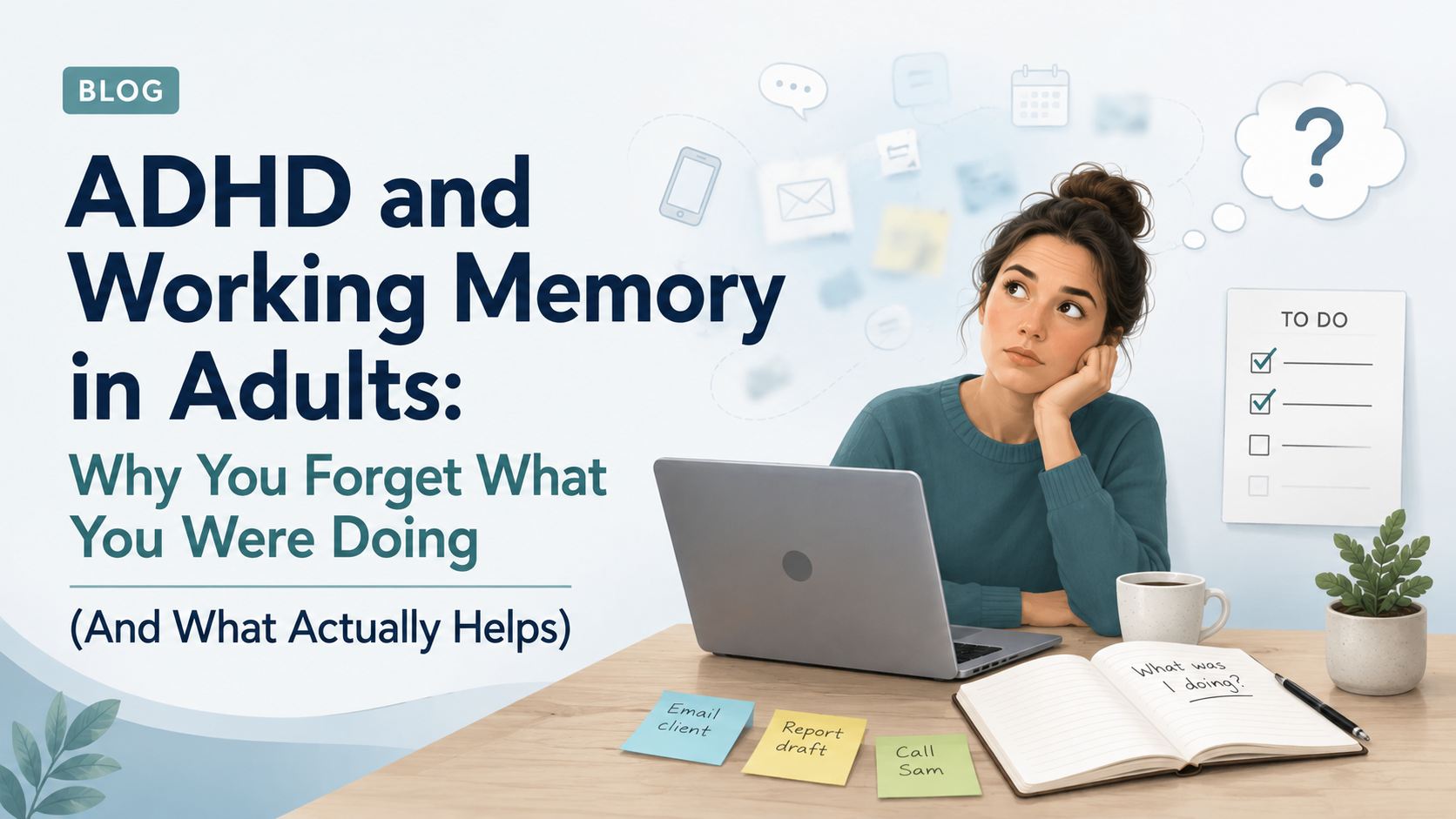
 ADHD and Working Memory in Adults: Why You Forget What You Were Just Doing (And What Helps)
You walk into the kitchen for a glass of water. Thirty seconds later, you’re standing there wondering why you came in. You start replying to an email, get interrupted for ten seconds, and completely lose your train of thought. You read the same paragraph four times because your brain slides off the words. If any of this sounds familiar, you are not lazy, and you are not “just tired.” You may be living with a working memory challenge that is common in adults with ADHD.
This article breaks down what working memory actually is, why ADHD affects it so directly, what these lapses look like in daily life, and — most importantly — what actually helps. The goal isn’t to hand you another vague list of “just use a planner” tips. It’s to explain the mechanism behind the forgetfulness, so the strategies make sense and actually stick.
What Working Memory Actually Is (And Why It’s Not the Same as Memory)
Working memory is the mental workspace you use to hold information active in your mind while you use it. Think of it as your brain’s whiteboard, not its filing cabinet. When you dial a phone number someone just read aloud, follow a recipe step without re-reading it, or keep track of what you were about to say while someone else is talking, you’re using working memory.
This is different from long-term memory, which stores information for days, years, or a lifetime. Working memory has a much smaller job: hold a few pieces of information, for a few seconds to a few minutes, so you can act on them. Researchers generally describe working memory as having two components — one that holds verbal information (like a sentence or a set of instructions) and one that holds visual-spatial information (like the layout of a room or the steps of a task).
Working memory sits at the center of executive function, the set of mental skills that let people plan, organize, and manage themselves toward a goal. According to the American Psychiatric Association’s overview of adult ADHD, executive function includes verbal and nonverbal working memory alongside planning, problem-solving, and emotional self-regulation. When working memory is weak, the entire executive function system has to work harder to compensate, which is exactly what happens in the ADHD brain.
Why ADHD Brains Struggle With Working Memory
ADHD is not a character flaw or a motivation problem. It’s a neurodevelopmental condition that affects how the brain regulates attention, impulse control, and executive function. The prefrontal cortex — the brain region responsible for holding information “online” and directing attention — tends to be less efficient in people with ADHD. This isn’t about intelligence. Plenty of highly intelligent adults with ADHD still lose their train of thought mid-sentence.
Part of the explanation involves dopamine and norepinephrine, two neurotransmitters that help regulate attention, motivation, and memory. In ADHD brains, these chemical messengers don’t fire and clear as efficiently, which makes it harder to keep information active and to filter out what doesn’t matter. That second part — filtering — is a big deal. Working memory isn’t just about holding information; it’s about protecting that information from being knocked out by every new sight, sound, or thought that shows up. As one clinical psychology practice explains, working memory specifically requires tuning out irrelevant information and distractions, which is precisely the skill that ADHD undermines. That’s why a text notification, a random thought, or someone walking past your desk can wipe out whatever you were holding in your mind a second ago.
This also explains why working memory problems and general forgetfulness are not identical. It’s possible to have a working memory problem without ADHD, and rare but possible to have ADHD without noticeable working memory issues. Still, research consistently finds a strong link between ADHD and reduced working memory capacity, which is why the two so often show up together in adults seeking a diagnosis.
Why You Forget What You Were Just Doing: The Real Mechanism
This is the moment most adults with ADHD want explained: you were mid-task, something happened, and now the task is gone. Here’s what’s actually going on.
Working memory has limited capacity, and ADHD shrinks it further. Most people can hold roughly three to five chunks of information active at once. In ADHD, that number tends to run lower, and the information decays faster once something else grabs attention.
Task-switching wipes the whiteboard. Every time you shift from one task to another — even briefly — your brain has to unload what it was holding and load something new. For most people, some of the original information survives the switch. For ADHD brains, the switch often clears the whiteboard entirely. That’s why answering a two-second question can make you completely lose track of the report you were writing.
Interoception and internal cues are weaker. Neurotypical brains often get a subtle internal nudge — “wait, I was doing something” — that pulls attention back on track. Many adults with ADHD don’t get that nudge reliably, so once a task drops out of working memory, there’s no automatic signal to retrieve it. It has to be found again from scratch, which is why you can stand in a room with no idea why you’re there.
Sensory and thought “noise” competes for the same limited space. A stray thought, an itch, background music, a memory that surfaces — all of it competes for the same small working memory workspace that the current task needs. In ADHD, that competition is less filtered, so distractions win more often.
None of this is a discipline problem. It’s a resource-and-filtering problem, and understanding that distinction changes what kind of help actually works.
 Working Memory vs. Attention: Two Different Problems That Look the Same
People often use “I can’t focus” and “I can’t remember what I was doing” interchangeably, but they describe two different mechanisms that happen to produce similar-looking chaos.
Attention determines what gets let into your mental workspace in the first place. Working memory determines whether it stays there once it’s in. You can have reasonably good attention and still lose information quickly if your working memory can’t hold onto it. You can also have strong working memory and still struggle if your attention keeps admitting the wrong things.
In ADHD, both systems are typically affected, which is part of why the day-to-day experience feels so chaotic. You get distracted (an attention problem), and even when you do refocus, you’ve lost the thread of what you were doing (a working memory problem). This one-two combination is why “just pay attention” advice feels so hollow to people living with ADHD — it addresses only half of what’s happening, and not even the half that’s usually causing the forgotten task in the first place.
Understanding this distinction matters practically. Attention strategies (removing distractions, using timers) and working memory strategies (external reminders, reducing steps held in your head) are not interchangeable. Adults who only address one side of the equation often find their systems half-work and then give up on them, concluding — incorrectly — that “nothing helps.”
What This Looks Like in Daily Life
Working memory challenges rarely show up as a single dramatic symptom. They show up as a hundred small frictions that quietly drain energy and confidence throughout the day.
At work, this might mean forgetting a task the moment a colleague interrupts you, losing the point of a meeting three sentences after someone else starts talking, or rereading the same email paragraph because the meaning slides away before you finish the sentence. Multi-step instructions are especially hard — by step three, step one has often already disappeared.
In conversations, you might lose your own point mid-sentence, especially in group settings with multiple speakers. This isn’t rudeness or disinterest. It’s the mental whiteboard getting overwritten by everyone else’s input before you can finish writing your own thought on it.
At home, this looks like walking into a room and forgetting why, starting five small tasks and finishing none of them, or losing track of where you put your keys, phone, or wallet multiple times a day. Cooking multiple dishes at once, following a multi-step recipe, or remembering which errand comes next in a sequence can all become disproportionately exhausting.
With money and admin tasks, working memory gaps show up as forgotten bill payments, abandoned online forms, and half-finished paperwork — not because the task was too hard, but because holding all its steps in mind long enough to finish it was the actual obstacle.
None of these examples reflect low intelligence or low effort. They reflect a brain that has to work much harder than average just to hold a thought steady long enough to act on it — and that extra effort adds up to real fatigue by the end of the day.
Common Myths About ADHD and Forgetfulness
A few persistent myths make working memory struggles harder to manage, mostly because they point people toward the wrong fix.
Myth: “You just need to try harder.” Working memory capacity isn’t primarily a matter of effort. Adults with ADHD are often trying far harder than their neurotypical peers just to hold onto the same amount of information, and that extra effort is invisible to everyone else. Telling someone to “try harder” adds pressure without addressing the actual bottleneck, which is capacity and filtering, not motivation.
Myth: “A better memory app will fix it.” Tools help, but only when they’re built into a routine that doesn’t itself rely on working memory to remember to use them. An app is useless if you forget it exists the moment you close it. The fix isn’t the tool; it’s designing a system with enough external structure that the tool gets used automatically, not by willpower.
Myth: “Smart people don’t have this problem.” Working memory and general intelligence are related but distinct. Plenty of highly capable, high-achieving adults with ADHD have significant working memory challenges. Many spend years masking the problem through sheer compensation — extra hours, over-preparation, constant re-checking — until the compensation strategies stop being sustainable, often during a period of higher stress or reduced sleep.
Myth: “This is just normal aging or normal busyness.” Some forgetfulness is universal. But if the pattern has been present since childhood, shows up across multiple areas of life (not just when you’re overloaded), and is paired with other ADHD traits like impulsivity or difficulty sustaining attention, it points to something more specific than a busy season of life. A proper evaluation can tell the difference.
Clearing up these myths matters because each one nudges people toward the wrong solution — more effort, more apps, more self-blame — instead of the structural changes that actually reduce the load on working memory.
The Hidden Cost: Self-Esteem, Relationships, and Burnout
Working memory struggles carry an emotional cost that often outweighs the practical one. Adults with ADHD frequently internalize years of being called forgetful, careless, or unreliable — labels that miss the actual cause entirely. Over time, this can chip away at self-esteem and create a persistent low-grade shame around ordinary tasks that other people seem to handle without effort.
Relationships absorb some of this strain too. A partner who forgets a conversation from yesterday, or a friend who repeatedly loses track of plans, isn’t necessarily careless — but repeated experiences like this can still hurt the other person and create friction if nobody understands the underlying cause. Naming the real mechanism (a working memory difference, not a character flaw) tends to reduce blame on both sides and opens the door to practical fixes instead of repeated apologies.
There’s also a compounding fatigue factor. Constantly re-finding lost tasks, re-reading missed information, and mentally reconstructing what you were doing takes real cognitive energy. Many adults with ADHD describe feeling disproportionately tired at the end of an ordinary day — not because the tasks were physically demanding, but because so much invisible effort went into simply holding onto them. This is a documented pattern in ADHD research on executive function, and it’s a major reason burnout shows up earlier and more often in adults with untreated or unsupported ADHD.
 What Actually Helps: Strategies That Work With an ADHD Brain, Not Against It
The most effective approach isn’t to try to force your brain to hold more information. It’s to reduce how much you’re asking your working memory to do in the first place, and to build external systems that do the remembering for you.
1. Get Information Out of Your Head and Onto Something External
Working memory has limited space, so the fewer things it has to hold, the better it performs. Write tasks down the moment they occur to you, rather than trying to “remember to remember.” A single trusted capture system — one notes app, one notebook, one whiteboard — works better than several scattered ones, because working memory also has to remember where you put the reminder.
2. Reduce Steps, Not Just Add Reminders
Multi-step tasks are especially hard because each step has to be held while the previous one is executed. Break tasks into the smallest possible single actions, and write out each step rather than trying to hold the whole sequence in mind. A recipe taped open to the right page, a checklist stuck to the front of the laundry machine, or a task broken into “open form,” “fill name,” “fill address” instead of “do the paperwork” all reduce the working memory load per step.
3. Lower the Interruption Cost
Since task-switching often wipes working memory clean, protecting focused blocks of time matters more for ADHD brains than for most. Turning off notifications during focused work, using a visible “do not disturb” signal, or working in short, timed sprints (a technique often called the Pomodoro method) can reduce how often the mental whiteboard gets erased mid-task.
4. Use Visual and Physical Anchors
Because ADHD often weakens the internal cue that says “you were doing something,” external cues can fill that gap. Leaving a physical object in an unusual spot, keeping the current task visibly open on a screen, or using a visible timer all give the brain something outside itself to notice and re-engage with.
5. Consider Working Memory Training and Professional Support
Some structured programs specifically target working memory capacity through repeated practice, and early research — including a controlled study on working memory training in adults with ADHD published in the Journal of Cognitive Psychology — has shown measurable improvements in attention and working memory performance after a structured training program. Results vary by individual, and training alone rarely replaces broader support, but it can be one useful piece of a larger plan.
Medication is also worth discussing with a prescriber. Stimulant and non-stimulant ADHD medications work on the dopamine and norepinephrine systems involved in attention and working memory, and many adults find that medication measurably reduces how often tasks slip away mid-stream. Medication isn’t the right choice for everyone, and it works best alongside behavioral strategies rather than instead of them.
6. Work With Someone Who Understands the ADHD Brain
Strategies that work well for neurotypical adults often fail for ADHD brains, not because the person isn’t trying, but because the strategy wasn’t built for this kind of working memory. Working with an ADHD coach can help translate general advice into systems that actually match how your brain holds and loses information — building routines, reminders, and task structures around your real patterns instead of an idealized version of productivity. This kind of tailored, ongoing support tends to outperform generic productivity advice precisely because it accounts for the mechanism described above, rather than treating forgetfulness as a willpower problem.
When to Seek Professional Support
Occasional forgetfulness is part of being human. But if working memory lapses are consistently affecting your job performance, relationships, finances, or daily functioning — and this pattern has been present since childhood or early adulthood — it’s worth talking to a doctor or licensed mental health professional about an ADHD evaluation. According to a CDC report summarized by CHADD, roughly 15.5 million adults in the United States have a current ADHD diagnosis, and more than half of them were diagnosed after age 18 — meaning a huge number of adults spent years attributing their symptoms to something else before getting an accurate explanation. You don’t have to keep guessing on your own.
A proper evaluation can also rule out other conditions that affect working memory, including anxiety, depression, sleep disorders, and thyroid issues, all of which can produce similar symptoms. Getting an accurate diagnosis matters because the right support depends on the right explanation.
Final Thoughts: ADHD and Working Memory in Adults — Why You Forget What You Were Just Doing (And What Helps)
Forgetting what you were just doing isn’t a personal failing. It’s a predictable result of how ADHD affects the brain’s working memory system — a limited mental workspace that holds information active only briefly, and that ADHD makes smaller, faster to clear, and easier to interrupt. Understanding this mechanism changes everything about how you respond to it. Instead of trying to force yourself to “just remember,” the real fix is building external systems, reducing unnecessary steps, protecting focus from interruptions, and getting the right professional support when needed. None of this requires more willpower. It requires the right tools for how your brain actually works.
If you’re ready to get your ADHD symptoms in order and build systems that actually stick, check out affordable ADHD coaching designed specifically around how the ADHD brain manages attention, memory, and daily life.