
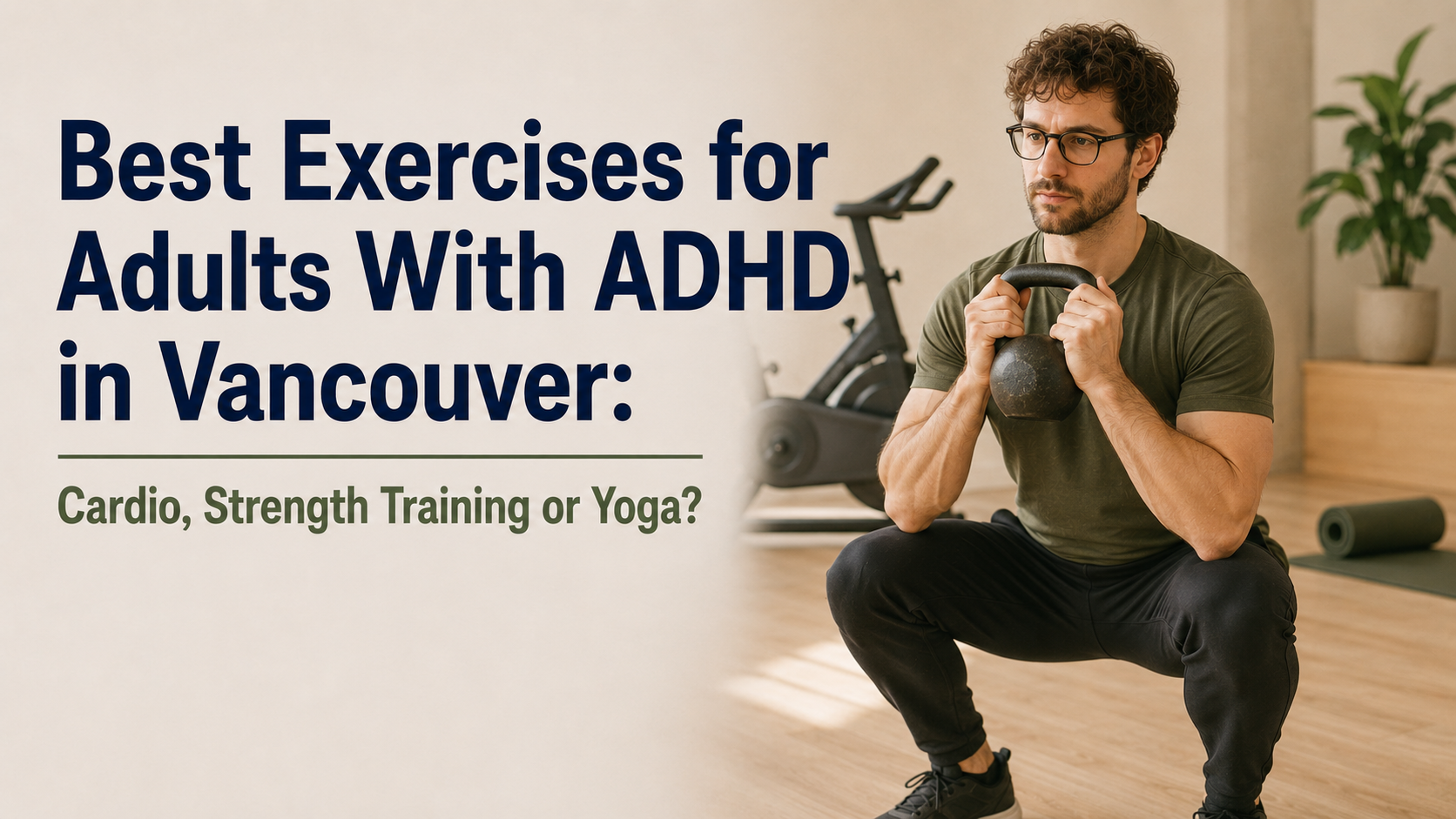
 Best Exercises for Adults With ADHD in Vancouver: Cardio, Strength Training or Yoga?
If you have ADHD, you’ve probably heard that exercise helps. What you may not know is which type of exercise actually helps most, and why. Cardio, strength training, and yoga all affect the ADHD brain differently. Some calm restlessness. Some sharpen focus. Some build the self-regulation skills that stimulant medication alone can’t teach.
This guide breaks down the science behind each option, then gets specific about how to put it into practice in Vancouver. You’ll find real routes, real facilities, and real strategies for adults whose brains resist routine. The goal isn’t to pick a “winner.” It’s to help you understand your options so you can build a routine you’ll actually stick with.
How Exercise Affects the ADHD Brain
ADHD is linked to lower baseline activity of two neurotransmitters: dopamine and norepinephrine. These chemicals regulate attention, motivation, and impulse control. Stimulant medications like methylphenidate work by increasing their availability in the brain. Exercise does something remarkably similar.
Physical activity increases dopamine, norepinephrine, and serotonin levels in the prefrontal cortex, the same neurotransmitters that ADHD medications target. This isn’t a coincidence. Research shows that moderate to intense exercise provokes changes in many of the same neurochemicals and brain structures affected by prescription ADHD medications. In other words, movement is doing real neurochemical work, not just burning off nervous energy.
The effects show up fast. A single 30-minute session of moderate exercise can produce immediate improvements in attention and impulse control, and the benefits compound with consistency. Exercise also triggers the release of brain-derived neurotrophic factor (BDNF), a protein that promotes neural plasticity, supports the growth of new brain cells, and strengthens connections in brain regions critical for attention and executive function.
There’s growing evidence that the ADHD brain may respond even more strongly to exercise than a neurotypical brain does. One review found that individuals with ADHD demonstrated significantly larger effect sizes in attention and inhibitory control measures after acute exercise compared to neurotypical controls. That’s a meaningful finding. It suggests exercise isn’t just “good for everyone” advice repackaged for ADHD. It’s targeting the specific systems that are underactive in ADHD brains.
None of this means exercise replaces treatment. It’s a support, not a cure. But understanding the mechanism matters, because it explains why different exercise types produce different results, which is the whole point of this guide.
For a deeper dive into the neuroscience, ADDitude Magazine’s overview of exercise and the ADHD brain is a well-sourced starting point.
Cardio for ADHD: The Fastest Way to Feel the Effects
Cardio is usually the first exercise type people associate with ADHD, and for good reason. Running, cycling, swimming, and brisk walking deliver the quickest neurochemical payoff. Aerobic exercise dramatically increases dopamine and norepinephrine in the short term, acting as a natural stimulant that’s especially helpful for mornings or before a task that requires focus.
This is why so many adults with ADHD describe a “clear window” after a run or a hard bike ride. Attention feels less scattered. Starting tasks feels less like pushing a boulder uphill. That window doesn’t last forever, but it’s real, and it’s useful. Many people time their most demanding work for the hour or so after a cardio session.
Cardio is also the easiest entry point for someone who struggles with structure. You don’t need equipment, a membership, or a plan. Lace up your shoes and walk. That low barrier matters enormously for ADHD brains, where friction — even small friction, like packing a gym bag — can be the difference between doing the workout and not.
The downside: cardio alone doesn’t do much for impulse control or emotional regulation. It’s excellent at increasing arousal and alertness (what researchers sometimes call hitting the “gas pedal”), but it does less to strengthen the brain’s “brake system,” the top-down control that helps you pause before reacting. That’s where strength training and yoga come in.
Practical cardio options that work well for ADHD:
- Short, intense sessions (20–30 minutes) rather than long, unstructured ones — novelty and intensity hold ADHD attention better than steady, monotonous cardio
- Interval-based workouts, which introduce built-in variety
- Activities with a social or competitive element, like a running club or recreational soccer league, which add accountability
If motivation is a recurring problem, it helps to read a bit about why that happens. CHADD’s overview of exercise and the ADHD brain explains the neuroscience of motivation deficits in more detail.
 Strength Training for ADHD: Building Focus Through Structure
Strength training gets less attention in ADHD conversations than cardio, but it offers something cardio doesn’t: structure. A workout built around sets, reps, and rest periods forces a kind of externally imposed organization that many ADHD brains find genuinely useful.
There’s also a cognitive engagement factor. Lifting weights with correct form requires moment-to-moment attention. You have to track your body position, your breathing, and your count, often while switching between exercises. This is different from cardio, where your mind is often free to wander (sometimes helpfully, sometimes not). Complex, skill-based movement appears to matter here. In lab studies, animals that practiced complex motor skills showed more dramatic increases in brain-derived neurotrophic factor than those doing simple, repetitive treadmill exercise, suggesting that movement complexity itself may add a neurological benefit beyond basic cardiovascular exercise.
Strength training also builds a specific kind of confidence that’s valuable for adults with ADHD, many of whom carry years of frustration around unfinished projects and missed goals. Progressive overload — adding a small amount of weight or another rep each week — gives concrete, visible proof of progress. That’s rare and valuable for a brain that often struggles to feel like effort is paying off.
There’s a practical routine benefit too. A structured strength program (say, three sessions a week following a fixed plan) creates a recurring commitment that can anchor other parts of your week. Many adults with ADHD find that once movement is scheduled and predictable, other habits — sleep timing, meal planning — start to stabilize around it.
Getting started with strength training in Vancouver doesn’t require a fancy setup. The City of Vancouver operates 25 public fitness centres across its community centres, many with a Flexipass option for unlimited drop-in access, which removes the commitment pressure of a long-term gym contract — useful if you’re not sure yet whether a routine will stick.
If you prefer outdoor strength work, several Vancouver parks have free public fitness equipment, including pull-up bars, dip stations, and body-weight circuits. Destination Vancouver’s list of parks with outdoor fitness equipment covers locations across the city, from Second Beach in Stanley Park to Douglas Park on the west side.
Yoga for ADHD: Training the Brain’s Brake System
Yoga tends to get dismissed by people with ADHD before they try it. Sitting still and breathing sounds like the opposite of what a restless brain wants. But this reaction misunderstands what yoga is actually training.
Where cardio revs up dopamine and norepinephrine (the “go” system), yoga and other mindful-movement practices work on a different mechanism. These practices support top-down self-regulation, meaning they improve the brain’s ability to pause rather than just its ability to activate. They build interoception, the awareness of what’s happening inside your own body, which directly supports emotional regulation and reduces impulsive reactions.
This matters because impulsivity and emotional reactivity are core ADHD symptoms that cardio doesn’t directly address. Exercise in general helps regulate the dopamine and norepinephrine levels involved in impulsive behaviour, but yoga specifically trains the skill of noticing an urge and choosing not to act on it immediately — a skill that translates directly into daily life, whether that’s pausing before an impulsive purchase or before an impulsive reply in an argument.
Yoga also addresses something less discussed but common in ADHD: physical restlessness combined with mental overstimulation at the same time. Slow, controlled movement paired with breath work can down-regulate an overstimulated nervous system in a way that vigorous cardio, which raises arousal, cannot.
That said, yoga is not a replacement for higher-intensity movement. It’s a complement. Many ADHD specialists suggest pairing a few weekly cardio or strength sessions with one or two yoga sessions, using yoga specifically on high-stress days or evenings when winding down matters more than revving up.
For adults who find traditional yoga classes hard to sit through, a few modifications help:
- Choose vinyasa or flow-style classes over slow, static styles — more movement keeps the brain engaged
- Try shorter 20-minute sessions rather than a full 75-minute class at first
- Practice at home with a timer-based routine, removing the social pressure of a studio
- Combine yoga with a body scan or breath-counting exercise to build the interoception skill more directly
Vancouver has a strong outdoor yoga culture, particularly through spring and summer. Kitsilano Beach regularly hosts community fitness and yoga sessions on its grassy areas, and several community centres run drop-in yoga as part of their regular programming.
 Cardio vs Strength Training vs Yoga: Which Should You Choose?
The honest answer is that this isn’t really a competition. Each type of exercise targets a different part of the ADHD symptom picture, and the research suggests different types of exercise serve different purposes — repetitive activities help reduce hyperactivity, while other forms support different cognitive functions. Choosing just one means leaving benefits on the table.
Here’s a simple way to think about it:
Choose cardio when you need an immediate boost before a demanding task, when motivation is low, or when you want the fastest, most reliable dopamine and norepinephrine response. It’s the best option for adults who are just starting out, because it requires the least planning and equipment.
Choose strength training when you want to build routine and structure into your week, when you’re looking for measurable progress to stay motivated long-term, or when you want a workout that demands sustained attention rather than letting your mind drift.
Choose yoga when emotional regulation, impulsivity, or racing thoughts are your main struggle, or when you need a way to wind down rather than rev up. It’s also worth prioritizing if you notice your ADHD symptoms are worse under stress, since yoga directly targets the nervous system’s stress response.
The realistic goal for most adults with ADHD is a mix: two or three cardio or strength sessions a week for the neurochemical and structural benefits, plus one or two shorter yoga or mindful-movement sessions for emotional regulation. You don’t need to follow this perfectly. Even a minimum of around 30 minutes of aerobic exercise a day is enough to produce a meaningful effect, so the goal is consistency over intensity.
If you’re unsure where to start, start with whichever option removes the most friction. For many people with ADHD, that’s a walk out the front door, not a gym membership they’ll forget to use.
Best Places in Vancouver to Exercise With ADHD in Mind
Vancouver has an unusual advantage for ADHD-friendly exercise: a mild, walkable climate and an enormous amount of free outdoor infrastructure. Novelty, scenery, and variety all help ADHD brains stay engaged, so it’s worth choosing locations that offer more than a treadmill and four walls.
Stanley Park Seawall. The seawall extends for about nine kilometres around Stanley Park, offering views of downtown Vancouver, the North Shore, Burrard Inlet, and the Lions Gate Bridge, and is popular for walking, jogging, and cycling. The changing scenery makes repetitive cardio far less monotonous, which matters for a brain that tunes out fast.
Kitsilano Beach. Kits Beach has volleyball courts, a dedicated running path, and open grassy areas suited to yoga, Pilates, or group workouts, making it one of the better spots in the city to combine cardio and mindful movement in a single outing.
Grouse Grind. Known locally as “Mother Nature’s Stairmaster,” the Grouse Grind offers an intense cardio and strength challenge for adults who want a harder, novelty-driven workout with a clear finish line — a structure that works well for goal-oriented ADHD brains.
Outdoor fitness parks. The city has numerous parks with free outdoor fitness equipment, including pull-up bars, dip stations, and circuit stations, at locations such as Second Beach, Douglas Park, and Hastings Park. These are ideal for strength training without the cost or scheduling pressure of a gym.
City of Vancouver fitness centres. For structured indoor strength training, the Park Board operates 25 fitness centres across the city, along with indoor pools, offering a Flexipass for flexible drop-in access without long-term contracts. This flexibility suits ADHD brains that don’t want to commit to a rigid schedule before knowing if it’ll work.
Mixing outdoor and indoor options throughout the week keeps things novel, which is often the real key to consistency for ADHD adults — not the specific exercise, but whether it stays interesting enough to repeat.
Building an Exercise Habit That Actually Sticks
Knowing that exercise helps ADHD is rarely the problem. Actually doing it consistently is. Motivation for ADHD brains isn’t driven by importance; it’s driven by interest, urgency, novelty, and challenge. A few practical strategies work with this wiring instead of against it:
Lower the barrier to starting. Keep gym clothes by the door. Choose a park five minutes from home instead of a gym across town. The goal is to remove every small decision between “I should exercise” and actually moving.
Attach exercise to an existing habit. Pairing a workout with something already automatic — right after coffee, right before checking email — uses habit stacking to bypass the need for willpower.
Use external accountability. A running group, a training partner, or a scheduled class creates a social commitment that’s often stronger than a personal one. ADHD brains frequently respond better to “someone is expecting me” than to “I told myself I would.”
Build in novelty on purpose. Rotate routes, try new classes, alternate between cardio, strength, and yoga through the week. Predictable routines that never change are often where ADHD motivation collapses fastest.
Track visible progress. A simple log of workouts completed, weights lifted, or distance run gives the ADHD brain the concrete feedback it craves, since abstract long-term health goals rarely feel motivating in the moment.
None of these strategies require perfect discipline. They’re designed to reduce the number of decisions and the amount of willpower needed at the moment you’re supposed to start, which is usually where ADHD habits break down.
When Exercise Isn’t Enough: Combining Movement With Other Support
Exercise is one of the most effective, evidence-based tools available for managing ADHD symptoms in adults. But it works best as part of a broader approach, not as a standalone fix. It doesn’t replace medication for people who need it, and it doesn’t replace the practical skills — planning, prioritizing, managing time, following through — that many adults with ADHD never had the chance to build.
This is where coaching often fills a gap that exercise alone can’t. A coach can help you translate the mental clarity you get from a good workout into an actual system: a way to plan your week, structure your tasks, and build habits that hold up on the days motivation doesn’t show up. Exercise gives you the neurochemical conditions for better focus. Coaching helps you use that focus for something.
 Common Questions About Exercise and Adult ADHD
How much exercise do I actually need for it to help my ADHD symptoms? There’s no single magic number, but most of the research points to roughly 30 minutes of moderate aerobic activity most days as a reasonable minimum. That said, shorter sessions still count. A 15-minute walk before a demanding meeting can be enough to shift focus for the next hour or so. The bigger driver of long-term benefit is consistency, not duration. Three imperfect 20-minute sessions a week will outperform one perfect 90-minute session that never gets repeated.
Can exercise replace ADHD medication? No, and it shouldn’t be framed that way. Exercise engages some of the same neurochemical systems that stimulant medications target, which is why the effects feel similar in the short term. But it’s a support tool, not a substitute for a full treatment plan. Many adults find the two work well together, using exercise to extend or smooth out the effects of medication rather than replace it.
What if I can’t get motivated to exercise in the first place? This is one of the most common ADHD paradoxes: knowing exercise helps and still struggling to start it. The fix usually isn’t more willpower. It’s removing friction. Lay out clothes the night before. Choose the workout that’s closest and easiest, not the one that’s theoretically best. Pair movement with something you already enjoy, like a podcast or a friend’s company. Momentum tends to build only after the first few minutes, so the entire goal at the start is simply getting moving, not performing well.
Is outdoor exercise really better than a gym for ADHD? Not necessarily better, but often easier to sustain. Outdoor environments introduce natural variation — changing light, weather, scenery, and terrain — that keeps an ADHD brain more engaged than a repetitive indoor routine. Vancouver’s mix of seawalls, beaches, and mountain trails makes this especially accessible. That said, the best environment is whichever one you’ll actually return to. Some people focus better indoors, away from distractions; others need the stimulation of the outdoors. Both are valid.
Conclusion: Best Exercises for Adults With ADHD in Vancouver
There’s no single best exercise for adults with ADHD. Cardio delivers the fastest neurochemical boost and the lowest barrier to entry. Strength training builds structure, sustained attention, and visible progress. Yoga trains the brain’s ability to pause, regulate, and manage stress. The real answer to “cardio, strength training, or yoga?” is that a rotation of all three, built around Vancouver’s parks, seawalls, and community fitness centres, will do more for ADHD symptoms than obsessing over which one is technically superior. Start with whichever option removes the most friction today, stay consistent more than you stay perfect, and let the routine grow from there.
If you’re ready to get your ADHD in order, check out affordable ADHD coaching in Vancouver. Combining a consistent exercise routine with the right coaching support can help turn short bursts of clarity into lasting, day-to-day change.