
 ADHD Body Doubling in Vancouver: What It Is, Why It Works & How to Try It
If you have ADHD, you already know the problem. You want to start a task. You even know how to do it. But something blocks you from actually beginning. This gap between intention and action has a name in the ADHD community: it’s the reason so many people turn to ADHD body doubling.
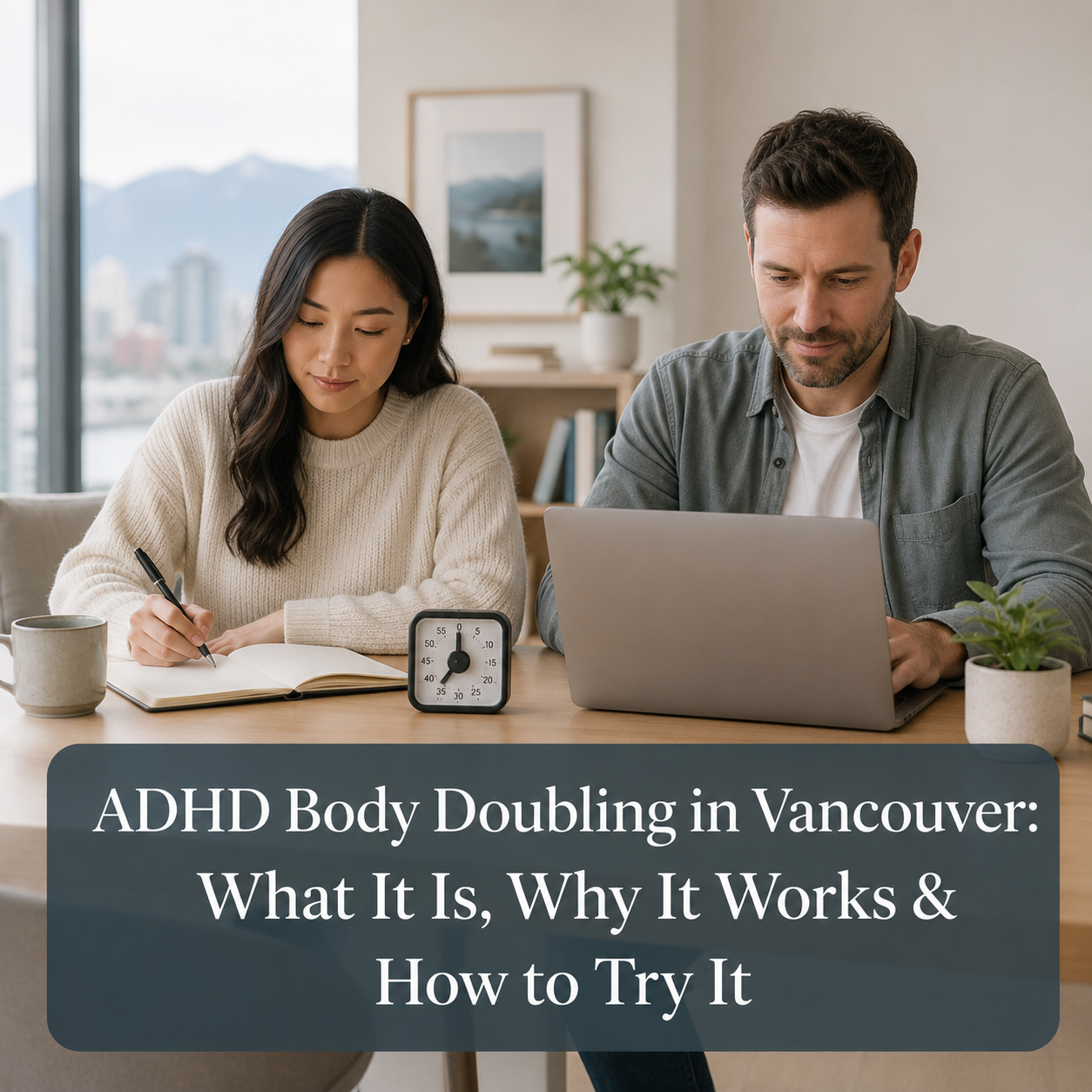
Body doubling is simple. You work next to another person, in silence or near-silence, while you both do your own separate tasks. No teaching. No supervision. Just presence. For many people with ADHD, that presence is enough to unlock focus that felt impossible alone.
This guide covers everything you need to know about ADHD Body Doubling in Vancouver: What It Is, Why It Works & How to Try It. You’ll learn what the practice actually is, what the science says about why it helps, where to find body doubling sessions around Vancouver, and how to get started this week.
What Is ADHD Body Doubling?
Body doubling means completing a task while another person is physically or virtually present. The other person isn’t coaching you. They’re not checking your work. They’re simply there, often doing their own unrelated task, while you do yours.
The term comes from the ADHD community itself, not from a clinical textbook. According to the Attention Deficit Disorder Association, “ADHD body doubling is a productivity strategy used by individuals with ADHD to finish possibly annoying jobs while having another person beside them.” It’s a grassroots strategy, built by people with ADHD, for people with ADHD.
Body doubling can happen almost anywhere. Two friends sit at the same table, each working on a different assignment. A parent folds laundry while their partner pays bills nearby. A student joins a video call where everyone works quietly on their own screen. What matters isn’t the task. What matters is the shared presence.
Vancouver has become a genuine hub for this practice. Between in-person coworking spaces, public libraries, ADHD-specific coaching studios, and a strong remote-work culture, the city offers more body doubling options than most Canadian cities. Local providers like Vancouver ADHD Coaching even run structured, recurring drop-in sessions built specifically around this idea.
It’s also worth being clear about what body doubling is not. It’s not therapy. It’s not a substitute for medication, coaching, or a diagnosis. It’s a low-cost, low-effort tool that sits alongside other supports. Think of it as scaffolding for the moment you need to start, not a treatment for ADHD itself.
 Why Body Doubling Works: The Psychology and Neuroscience
Body doubling looks almost too simple to work. So why does sitting near a quiet stranger help someone start a task they’ve avoided for weeks? The answer draws on several well-established psychological principles, even though body doubling itself hasn’t been studied extensively as a standalone intervention.
Social facilitation. Psychologists have known for over a century that people often perform simple or well-practiced tasks better when someone else is present. This is called the “mere presence effect,” and it isn’t unique to humans — researchers have observed similar patterns in other social species. Having someone nearby, even someone not interacting with you, changes how your brain allocates attention.
Externalized accountability. ADHD affects executive function — the brain’s internal system for planning, starting, and sustaining effort. Clinical experts describe body doubling as a way of externalizing motivation. Russell Ramsay, a clinical psychiatry professor and co-director of the University of Pennsylvania’s ADHD treatment and research program, has noted that while extensive research on the strategy’s effect on productivity doesn’t exist, the idea of externalizing motivation is a longstanding evidence-based mechanism for managing ADHD. In plain terms: your brain borrows structure from someone else’s presence because generating that structure internally is harder for an ADHD brain.
Dopamine and reward. ADHD is linked to differences in dopamine regulation, which affects motivation and the sense of reward from completing tasks. Social interaction is one of the most reliable natural boosters of dopamine activity. Some clinicians argue that this social spark may be why a body double makes an otherwise boring task feel more tolerable, giving executive function a small but real boost.
Reduced avoidance behavior. A 2018 review on ADHD theory notes that reduced motivation plays a central role in the condition, weakening the psychological reward tied to finishing tasks. Having someone else present may make boring tasks more pleasurable, helping people overcome that motivational gap, and for people with hyperactivity, a calm companion may also help reduce restlessness by modeling focused behavior.
None of these mechanisms are exclusive to ADHD. But for a brain that struggles specifically with task initiation and sustained attention, they combine into something genuinely useful.
Is There Real Research Behind Body Doubling?
Honesty matters here, and it’s worth being upfront: body doubling is not a clinically proven treatment. It’s a community-developed strategy, and the direct research on it remains limited.
That said, it isn’t a fad without any scientific grounding either. A recent EEG-based study on body doubling and ADHD, published through the ACM SIGACCESS Conference on Computers and Accessibility, found early evidence that the practice appears safe and potentially beneficial, particularly for people with ADHD who aren’t on medication, even though the study didn’t find statistically significant group-level effects. Researchers involved in that work describe body doubling as a widely used strategy in neurodivergent communities to support focus and task completion, popularized through social media and peer-to-peer support groups, but one that still lacks strong empirical validation.
Other academic reviews echo this cautious framing. One 2026 analysis in Simply Psychology concluded that direct evidence is thin, based on surveys, small studies, and clinical consensus rather than randomized trials — meaning body doubling is best understood as a low-risk, community-validated strategy with plausible mechanisms, not a proven treatment.
What this means practically: try body doubling with realistic expectations. It’s not going to fix executive dysfunction on its own. But it costs little, carries essentially no downside, and has enough anecdotal and clinical support that ADHD coaches, therapists, and psychiatrists across Canada and the US regularly recommend it. If it works for you, use it. If a particular format doesn’t click, try a different one before giving up on the concept entirely.
Finding In-Person Body Doubling in Vancouver
Vancouver’s mix of public infrastructure, coworking culture, and ADHD-specific services makes in-person body doubling more accessible here than in many cities. Here’s where to look.
Public libraries. The Vancouver Public Library offers quiet study rooms and open reading areas across its branches, including the Central Library downtown. While libraries don’t formally brand their space as “body doubling,” the environment functions the same way: a room full of people quietly focused on their own work creates the same social facilitation effect described earlier. Bringing a friend and sitting at the same table, each working independently, is a free and easy way to start.
Coworking spaces. Vancouver has a dense coworking scene, and open desk areas naturally support body doubling even without a formal program. Working from a shared table, rather than a private booth, gives you the ambient presence that makes the practice effective.
ADHD-specific coaching studios and support groups. This is where Vancouver stands out. Local ADHD coaching practices run structured drop-in and membership-based body doubling sessions designed specifically for neurodivergent adults, often alongside coaching and community support. Long-running local supports have also existed for decades — the city’s original Vancouver Adult ADD Support Group, connected to Vancouver ADHD coach Pete Quily, has offered peer connection since 1993, and remains a useful entry point for finding current local groups and resources.
CADDAC’s resource navigator. The Centre for ADHD Awareness, Canada (CADDAC) maintains a national resource finder and a regional list of support groups, including options in British Columbia. It’s a reliable starting point if you’re not sure what’s currently active near you, since community groups tend to shift over time.
Cafes with communal seating. Informal but effective. Choose a cafe with shared tables rather than isolated booths, and treat the surrounding activity as your body double. This costs nothing but a coffee and works well for people who find total silence too sterile.
If you’re new to body doubling, in-person options tend to be the most immersive starting point, because the accountability feels more concrete. But they’re not the only option — and for many people in Vancouver, virtual sessions turn out to be more sustainable long-term.
 Virtual Body Doubling: Options That Work From Anywhere
Not everyone can get to a library or coworking space during their most productive hours. Virtual body doubling solves that problem, and it has grown into a legitimate industry of its own over the past several years.
Focusmate is the best-known platform. You book a session, get matched with another member over video, briefly state your goal, work quietly on your own task with your camera on, and check in with each other at the end. Sessions typically run 25, 50, or 75 minutes. Focusmate reports that neurodivergent members, including those with ADHD, see a 161% increase in productivity on average — 33% higher than neurotypical members using the platform, based on its own internal research.
Other platforms follow a similar model with different formats. Some, like Flow Club, run themed group coworking rooms with a host guiding structured focus blocks. Others operate as always-on drop-in rooms rather than scheduled one-on-one sessions, which suits people who don’t want to commit to a booked time slot.
Locally, some Vancouver ADHD coaching services run their own recurring virtual body doubling sessions as part of a broader membership or community offering, combining the accountability of a scheduled session with the familiarity of a consistent group.
Virtual body doubling has one clear advantage over in-person options: it removes almost every barrier to starting. There’s no commute, no need to leave the house, and sessions are available at almost any hour, which matters if your ADHD symptoms are worse at inconvenient times of day. The tradeoff is that some people find video calls with strangers a bit awkward at first. Most platforms address this directly — cameras and microphones are typically optional, and the norm is minimal interaction beyond a brief hello and goodbye.
How to Try Body Doubling: A Practical Step-by-Step Guide
Getting started with body doubling doesn’t require research or planning. Here’s a simple approach that works whether you’re trying it in person or online.
Step 1: Pick one specific task. Vague goals like “be productive” don’t work well for body doubling. Choose something concrete: “reply to these five emails,” “fold this basket of laundry,” or “write the introduction to my report.” Specificity matters more than difficulty.
Step 2: Choose your format. Decide between in-person and virtual based on your schedule and energy that day. If you’re low-energy or short on time, a virtual Focusmate session might be easier to commit to than getting dressed and driving to a coworking space.
Step 3: Set a timer. Most body doubling sessions run 25 to 50 minutes, similar to a Pomodoro-style focus block. A defined end time makes the task feel finite, which reduces the dread that often blocks task initiation for ADHD brains.
Step 4: State your goal out loud (or in text). If you’re on a platform like Focusmate, or sitting with a friend, say what you’re about to work on. This small act of verbal commitment appears to be part of what makes the format effective — it’s the difference between a vague intention and a stated plan.
Step 5: Work without checking in mid-session. The point isn’t conversation. Let the other person’s presence do the work quietly, and resist the urge to chat until the session ends.
Step 6: Check out at the end. Briefly report what you accomplished, even if it’s just to yourself. This closes the loop and reinforces the sense of completion that ADHD brains often struggle to register internally.
Step 7: Repeat on a schedule. One session rarely creates lasting change. The real benefit shows up when body doubling becomes a predictable part of your week — the same way a workout only helps if you keep showing up.
Body Doubling and ADHD Coaching: How They Complement Each Other
Body doubling and ADHD coaching solve different problems, and understanding the difference helps you use both well.
Body doubling addresses the moment-to-moment struggle: starting a task, staying with it, and finishing it. It’s tactical. It works session by session, and its benefits are immediate but temporary — the structure disappears once the session ends.
ADHD coaching works at a different level. A coach helps you understand your specific patterns — why certain tasks trigger avoidance, how your energy fluctuates through the day, what systems actually fit your brain rather than a generic productivity template. Coaching builds the frameworks that body doubling sessions then get used inside.
Used together, they reinforce each other well. A coach might help you identify that mornings are your best focus window and that email is your biggest avoidance trigger. Armed with that insight, you can schedule a recurring body doubling session specifically for email on weekday mornings, rather than trying it randomly and wondering why it doesn’t stick.
Group coaching programs run through organizations like CADDAC combine structured coaching content with peer accountability, which mirrors this same principle at a larger scale. If you’ve tried body doubling on its own and found it helpful but insufficient — if you can start tasks in the moment but still feel like your overall systems are chaotic — coaching is usually the missing piece.
 Common Challenges (and How to Work Through Them)
Body doubling isn’t magic, and it doesn’t work identically for everyone. A few common friction points come up often, along with practical ways to address them.
“It feels awkward with a stranger.” This is one of the most common hesitations, especially with virtual platforms. Most services are built around minimal interaction — a short hello, a brief goal statement, and a quick check-out. You’re not expected to make conversation. Give it two or three sessions before deciding it’s not for you; the awkwardness usually fades quickly.
“I get distracted talking instead of working.” This happens most often with friends or family rather than strangers. If a familiar body double keeps turning into a chat session, that’s a sign to try a more structured platform with built-in norms, or to explicitly agree on a no-talking rule before you start.
“I can’t find a consistent time that works.” Rotate between in-person and virtual options depending on your week. A drop-in virtual platform removes the scheduling friction of in-person meetups, and many run sessions early morning through late evening.
“One session didn’t fix anything.” That’s expected. Body doubling works cumulatively, similar to exercise. A single session might help you finish one task; a consistent weekly rhythm is what changes your overall relationship with procrastination.
“It works for some tasks but not others.” This is normal and useful information. Many people find body doubling most effective for tedious, low-stimulation tasks — paperwork, tidying, admin — and less necessary for tasks they already find engaging. Save it for the tasks you’re most likely to avoid.
Conclusion: Making ADHD Body Doubling Work for You in Vancouver
ADHD Body Doubling in Vancouver: What It Is, Why It Works & How to Try It comes down to one central idea: presence helps. Working alongside another person, whether in a library, a coworking space, or a video call through a platform like Focusmate, can make the difference between a task that stays stuck on your to-do list and one that actually gets done.
The science behind it is still developing, and no researcher will tell you it’s a proven cure for anything. But the mechanisms that plausibly explain why it works — social facilitation, externalized accountability, and a small dopamine boost from social presence — are well established on their own, and thousands of people with ADHD report real results from the practice.
Vancouver offers more ways to try this than most cities: public libraries, coworking spaces, long-running local support groups, and dedicated ADHD coaching studios that run structured sessions built around this exact idea. Start small. Pick one task, one 25-minute session, one format. See how it feels before deciding whether to build it into your week.
If body doubling helps you start tasks but you’re still looking for a bigger-picture approach to managing your ADHD — routines, systems, and strategies built around how your brain actually works — affordable ADHD coaching can help you get your ADHD in order. It’s a natural next step once you’ve felt what focused, supported work can feel like.